A Program of the Hudson River Estuary Program
Compiled by Tom Lake, Consulting Naturalist
Overview
We are back from a Holiday hiatus with a three-week Almanac that took us through the Winter Solstice. Highlights included Christmas Bird Counts, a banded wintering bald eagle from a faraway place, an Arctic seabird making only its second appearance in Orange County and, despite the season, there were still fish to be had.
Highlight of the Week
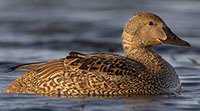 12/15 – Orange County, HRM 39: A female king eider (Somateria spectabilis) was spotted yesterday and again this morning at Sterling Lake. It was there for two days and then left. The only other sighting of a king eider in Orange County (also a female) occurred during an E.A. Mearns Bird Club field trip on September 26, 1981 (for one day) in Cornwall Bay. (Photo of king eider courtesy of Martin Garner) 12/15 – Orange County, HRM 39: A female king eider (Somateria spectabilis) was spotted yesterday and again this morning at Sterling Lake. It was there for two days and then left. The only other sighting of a king eider in Orange County (also a female) occurred during an E.A. Mearns Bird Club field trip on September 26, 1981 (for one day) in Cornwall Bay. (Photo of king eider courtesy of Martin Garner)
– Ken McDermott
[King eider is a big sea-duck of circumpolar Arctic waters. They are well adapted to frigid climates, diving and swimming underwater in seas near the freezing point and resting on ice floes. They winter in Arctic and subarctic marine areas, most notably the west coast of Greenland, eastern Canada and northern Norway often in large flocks some of which can exceed 100,000 birds. Kenn Kaufmann]
Natural History Entries
12/14 – Columbia County, HRM 128: Our Hudson-Mohawk Bird Club completed our 32.94-mile Southeast Quadrant Christmas Bird Count survey in Chatham-Kent, Columbia County. Notable among the 30 documented species were 29 wild turkeys (feeding under oak trees), five woodpeckers (red-bellied, downy, hairy, pileated, and northern flicker), 67 blue jays, 650 American robins, one each common raven, eastern bluebird, northern mockingbird, song sparrow, cedar waxwings (77), northern cardinals (9), American tree sparrows (4), Carolina wrens (2), and red-tailed hawks (4).
– Nancy Kern (Hudson-Mohawk Birds)
12/14 – Ulster County, HRM 96-86: We held our 70th annual Ulster County Mohonk Lake-Ashokan Reservoir Audubon Christmas Bird Count. Fifty-one (51) participants in fifteen (15) field parties counted 10,711 birds representing 75 species, plus four (4) additional count-week species.
Extremely dense fog with rain showers persisted throughout the count day, severely limiting visibility. Combined with mild air temperatures, exposed ground, and generally open water, there was little incentive for birds to congregate. Diversity was three species below our ten-year average of 78 and twelve shy of our all-time record high of 87 species recorded in 2017. Total abundance was well below our ten-year average of 13,897 individuals and less than half our record high 22,307 in 2017.
Highlights included two marsh wrens that represented a new species to the count composite advancing our historical cumulative to 148 species. Also noteworthy for this count circle was a barn owl that was only our second historical record, previously encountered in 1953. A field party inadvertently flushed a short-eared owl from a patch of tall cover crop, representing our second count record for this species previously recorded in 1985.
Two species of shorebirds lingered in the count circle, a killdeer (6th record) and a Wilson’s snipe that was flushed from pond-side vegetation in High Falls (5th count record). A total of 14 red-headed woodpeckers were found dispersed over multiple locations, a remarkable increase compared to our previous high count of 7 recorded just last year. Northern flickers were also encountered in remarkably high numbers, establishing a new high count of 77 compared to 47 in 2017. Horned larks (11) and snow buntings (16) were found at just one agricultural site, while belted kingfishers (5) and great blue herons (5) were scattered throughout the count area.
– Steve Chorvas, Kyla Haber, Mark DeDea
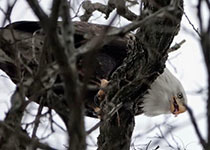 12/14 – Town of Wappinger, HRM 67.5: Bald eagle nest NY459, stuck in a crotch of a tall oak high above the tidal Wappinger Creek, has had a precarious history. In May 2018, the nest was destroyed by straight-line winds associated with a severe storm that included tornadoes. Two nestlings survived that collapse and three more nestlings were fledged in 2019. The nest always seems rickety and in need of repair, and today, both adults were on station, one of which had a small fish (white perch?) protruding from its mouth. (Photo of bald eagle nest courtesy of Brenda Miller) 12/14 – Town of Wappinger, HRM 67.5: Bald eagle nest NY459, stuck in a crotch of a tall oak high above the tidal Wappinger Creek, has had a precarious history. In May 2018, the nest was destroyed by straight-line winds associated with a severe storm that included tornadoes. Two nestlings survived that collapse and three more nestlings were fledged in 2019. The nest always seems rickety and in need of repair, and today, both adults were on station, one of which had a small fish (white perch?) protruding from its mouth. (Photo of bald eagle nest courtesy of Brenda Miller)
– Brenda Miller, Dana Layton, Sheila Bogart
12/15 – Albany County, HRM 145-133: Our Hudson-Mohawk Bird Club completed our Sector B of the Albany County Christmas Bird Count survey that runs from Delmar south to Coeymans. Notable among the 41 documented species were two gray catbirds, a chipping sparrow, a merlin, a great blue heron, and 27 red-tailed hawks. Our most abundant species were American Crow (2,320), European starling (938), rock pigeon (445), and Canada goose (392).
– John Kent, Larry Alden, Tristan Lowery (Hudson-Mohawk Birds)
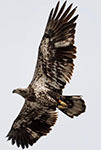 12/15 – Ulster County, HRM 83: I photographed an immature bald eagle today along the Wallkill River in Tillson that had a burnt-orange leg band with number 0709-05757. After a bit of research, it was determined that the eagle had been banded on May 30, 2018, at Richmond Pond, Berkshire County, Massachusetts and had been free for 576 days. The eagle weighed 8.5 pounds at banding and its sex could not be determined. This was the first chick hatched by the adults. (Photo of banded bald eagle courtesy of Jim Yates) 12/15 – Ulster County, HRM 83: I photographed an immature bald eagle today along the Wallkill River in Tillson that had a burnt-orange leg band with number 0709-05757. After a bit of research, it was determined that the eagle had been banded on May 30, 2018, at Richmond Pond, Berkshire County, Massachusetts and had been free for 576 days. The eagle weighed 8.5 pounds at banding and its sex could not be determined. This was the first chick hatched by the adults. (Photo of banded bald eagle courtesy of Jim Yates)
– Jim Yates
12/15 – Manhattan, New York City: The Randall’s Island Park Alliance Staff Educators conducted our Randall’s Island Bird Count today. We were fortunate to have Molly Adams from New York City Audubon to help us identify the birds. It was great having extra pairs of eyes to count all the brant and Canada geese. Most notable among the 1,425 total birds were brant (744), Canada geese (296), snow geese (2), gadwall (23), red-breasted merganser (3), yellow-crowned night heron (1), peregrine falcon (1), merlin (1), American kestrel (1), red-tailed hawk (3), and one raven.
– Jackie Wu
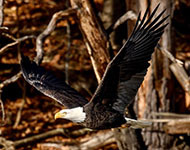 12/16 – Friday-Saturday, January 10-11, 2020: This will be the forty-first annual Mid-Winter Bald Eagle Census for the Hudson River watershed. We will be compiling bald eagle (and golden eagle) sightings from anywhere and everywhere in the watershed. Our data will then be forwarded to the U.S. Army Corps of Engineers, the lead agency for data collection. If you come across eagles on those days, please e-mail the precise date and location of the sighting, whether bald eagle or golden eagle, and if they were adult or immature, to: trlake7. (Photo of bald eagle courtesy of Jim Yates) 12/16 – Friday-Saturday, January 10-11, 2020: This will be the forty-first annual Mid-Winter Bald Eagle Census for the Hudson River watershed. We will be compiling bald eagle (and golden eagle) sightings from anywhere and everywhere in the watershed. Our data will then be forwarded to the U.S. Army Corps of Engineers, the lead agency for data collection. If you come across eagles on those days, please e-mail the precise date and location of the sighting, whether bald eagle or golden eagle, and if they were adult or immature, to: trlake7. (Photo of bald eagle courtesy of Jim Yates)
– Tom Lake
12/16 – Millbrook, HRM 82: I had six coyotes march by my trail camera over a period of several minutes today. This presumably is the family whose home range includes my property, and the pups will be sent packing in a month or so. Apparently 5-6 is the average litter size, so four surviving adults seems about right.
– Nelson Johnson
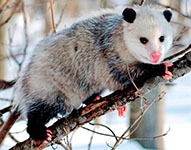 12/17 – Germantown, HRM 108: As I was looking out my kitchen window in midday, I spotted an adult opossum meandering over a snow-covered hillside. Last week, also at midday, I saw a smaller opossum below my kitchen window in a path I shovel for our cat to get to his cat door. After the first sighting, thinking that opossums were entirely nocturnal, I wondered if it was rabid. But after the second one, given the onset of winter, I began to think the behavior was not totally abnormal. (Photo of opossum courtesy of William Comcowich) 12/17 – Germantown, HRM 108: As I was looking out my kitchen window in midday, I spotted an adult opossum meandering over a snow-covered hillside. Last week, also at midday, I saw a smaller opossum below my kitchen window in a path I shovel for our cat to get to his cat door. After the first sighting, thinking that opossums were entirely nocturnal, I wondered if it was rabid. But after the second one, given the onset of winter, I began to think the behavior was not totally abnormal. (Photo of opossum courtesy of William Comcowich)
– Ripley Hathaway
[The Virginia opossum (Didelphis virginiana) is a marsupial, in that their young are carried in a pouch not unlike kangaroos. The name “opossum” was phonetically translated from an Algonquian word (powhatan) and first recorded by John Smith (1607) in Virginia. Opossums originated in South America and entered meso-America and then North America about 40 million years ago over a Panama land bridge. Since opossums do not hibernate, they can face desperate conditions in winter when the weather can cause frostbite on their tails, paws, and ears. Their dens, where they wait out bad weather, are typically underground beneath brush piles or in hollowed trees. It is not uncommon to see opossums out and about year-round. Tom Lake]
12/18 – Manhattan, HRM 1: We checked The River Project’s collection gear on the steamship Lilac, moored at Pier 25 in Hudson River Park, and found a lone young-of-year striped bass (85 mm). The fish had a wound on its back that had healed, but spoke of an encounter with a predator, possibly a blue crab.
– Siddhartha Hayes, Melissa Rex, Toland Kister
[Note: one inch = 25.4 millimeters (mm)]
12/19 – Greene County, HRM 124-113: We held our Coxsackie-Catskill Christmas Bird Count two days late this year due to snowy and icy conditions on December 17. Weather conditions were similar this season to last, with an early heavy snowfall and unusually early extreme cold air temperatures. Our species count (61) was a little lower than average, but the overall number of birds (13,399) was almost twice the number from last year’s low (7,657).
Like last year, waterfowl species and numbers were lower than average as the count tallied only mallards, black ducks, common mergansers, buffleheads, hooded mergansers, and Canada geese. Among the oddities were a hermit thrush and an almost breeding-plumage-bright chipping sparrow. Bald eagle numbers (48) were impressive. Over the last decade, eagle Christmas Bird Count numbers have ranged from a low of six in 2009 to a high of 67 in 2018. We also saw a modest increase in the number of black vultures at six (we counted five in 2018).
– Larry Federman
12/19 – Town of Wappinger, HRM 68: What appeared from a distance to be a white-tailed deer carcass was lying out in a snowy field, 200 feet from the road. The carcass had attracted company. A red-tailed hawk was fast at work stripping the rib cage. Six patient black vultures were arranged in a ring around the hawk at a respectable distance.
I returned to the site an hour later. The hawk had had its fill, and the vultures had scavenged what was left. Walking to the site, I could see a three-legged drag in the snow – it had been a vehicle strike. This was a young deer that showed considerable shoulder trauma on one side. It had been hit, dragged itself 200 feet, and then gave up.
– Tom Lake
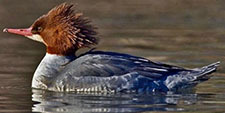 12/20 – Wappinger Creek, HRM 67.5: Overnight cold (11 degrees F) had drawn out the ice from the shallows to the deeper water of Wappinger Creek. A half-dozen hen and drake common mergansers were mingling in the midday low tide. An adult bald eagle was perched in a sycamore not six wing-beats away. The ducks seemed complacent. We often wonder if prey can sense when predators are not on the hunt. By sundown, the tidewater was fully iced over. (Photo of common merganser courtesy of Jan Nagalski) 12/20 – Wappinger Creek, HRM 67.5: Overnight cold (11 degrees F) had drawn out the ice from the shallows to the deeper water of Wappinger Creek. A half-dozen hen and drake common mergansers were mingling in the midday low tide. An adult bald eagle was perched in a sycamore not six wing-beats away. The ducks seemed complacent. We often wonder if prey can sense when predators are not on the hunt. By sundown, the tidewater was fully iced over. (Photo of common merganser courtesy of Jan Nagalski)
– Tom Lake, B.J. Jackson, T.R. Jackson
[While the drake common merganser is one of the most beautiful of diving ducks, the hen common merganser is also quite handsome. With her fly-away red-feathered head, she always reminds me of Elsa Lanchester in the 1935 movie of Mary Shelley’s “Bride of Frankenstein.” Tom Lake]
12/21 – Hyde Park, HRM 82: We had a “menorah” of northern flickers, at least five, in the yard this morning. I had never had more than two at a time. Most of them appeared to be females. That made six species of woodpecker in my yard this week, including red-bellied, downy, hairy, yellow-bellied sapsucker, and pileated.
– Peter Fanelli
[The word “menorah” is Hebrew for “lamp,” and generally refers to either the seven-branched golden candelabra that was lit every day in the Tabernacle and then the Holy Temple in Jerusalem, or the eight-flamed lamp that is lit on the eight nights of the Jewish holiday of Chanukah. Yacov Newman, Gavriel Sivan]
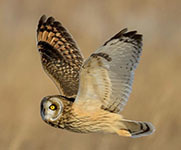 12/21 – Ulster County, HRM 74: The short-eared owls were up early today during my visit to the Shawangunk Grassland National Wildlife Refuge in Galeville. While they were not flying much, they were perched all over. A few of them came close to my blind, but the closest approaches were into the sun. As the “golden hour” arrived (time of peak activity), the owls moved farther out into the fields making photography a challenge. (Photo of short-eared owl courtesy of Jim Yates) 12/21 – Ulster County, HRM 74: The short-eared owls were up early today during my visit to the Shawangunk Grassland National Wildlife Refuge in Galeville. While they were not flying much, they were perched all over. A few of them came close to my blind, but the closest approaches were into the sun. As the “golden hour” arrived (time of peak activity), the owls moved farther out into the fields making photography a challenge. (Photo of short-eared owl courtesy of Jim Yates)
– Jim Yates
12/21 – Millbrook, HRM 82: During my annual bluebird nest-box clean-out, one nest caught my eye. It was in a box often used by house wrens, and the builder had constructed the nest entirely of leafless fir twigs plus a few percent animal hair. The fir twigs were readily available under the several nearby firs, but a myriad of other twigs and stems also were readily available from dozens of different plant species. Scientists have suggested that birds choose their nest sites in part to avoid parasites, and I wondered whether this bird had chosen its nesting materials for the same reason. Firs (Abies sp.) contain significant levels of chemicals called monoterpenes. Monoterpenes are well-known insecticides and acaricides. It is, indeed, a standard bluebird nest box, but my nest boxes seem to be used by tree swallows and house wrens as well. My impression is that the nest boxes in the fields are used by tree swallows, the one by my pond is used by bluebirds, the one by my woodshed is used by house wrens, and the one by the road is used by nobody at all.
– Nelson Johnson
12/21 – Hudson River Watershed: The Winter Solstice arrived today at 11:19 PM.
– National Weather Service
[The Winter Solstice is an astronomical phenomenon marking the day with the shortest period of daylight and the longest night of the year. The winter solstice occurs at the moment when the Earth’s tilt away from the sun is at a maximum (23.5 degrees relative to its orbit). At New York, sunset today was 4:31 PM; sunrise tomorrow will be 7:16 AM; sunset tomorrow will be 4:32 PM. That will give us 14 hours and 45 minutes of night tonight, leading into tomorrow, and then 9 hours and 15 minutes of daylight – long night, short day. Tom Lake]
12/22 – Schenectady County, HRM 157: Twenty-eight birders in nine field parties found a total of 58 bird species during our Schenectady Christmas Bird Count. The misty rain and warmer air on the cold snow made for fog, which made birding challenging. Among the highlights were green-winged teal, red-breasted merganser, black vultures (35), sharp-shinned hawk, bald eagles (4), eastern screech-owl, great horned owl, American kestrel, common raven, red-breasted nuthatch, brown creeper, hermit thrush, and red-winged blackbirds (12).
– Larry Alden (Hudson-Mohawk Birds)
*** Fish of the Week ***
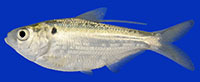 12/22 – Hudson River Watershed: Fish-of-the-Week for Week 51 is the gizzard shad (Dorosoma cepedianum), number 28 (of 230) on our watershed list of fishes. If you would like a copy of our list, e-mail – trlake7. 12/22 – Hudson River Watershed: Fish-of-the-Week for Week 51 is the gizzard shad (Dorosoma cepedianum), number 28 (of 230) on our watershed list of fishes. If you would like a copy of our list, e-mail – trlake7.
The gizzard shad is one of nine herrings (Clupeidae) in our watershed and the only true freshwater herring. They are a nonnative herring and are believed to have made their way into the estuary decades ago via the Intracoastal Waterway from Delaware Bay or points south, or through the canal system from Lake Erie (C.L. Smith). J.R. Greeley, in his A Biological Survey of the Lower Hudson Watershed (1937), could not find them in the lower Hudson. Their peculiar common name comes from their stomach that is not unlike the gizzard of certain birds, as well an epibranchial pouch near their gills that serves as a food storage organ (ibid.).
Gizzard shad are a winter favorite of bald eagles due to their vulnerability to the rigors of a northern winter, frequently succumbing to a phenomenon known as “winter kill.” Studies have shown (Jester and Jensen 1972) “high mortality rates at water temperatures below 2.2 degrees Celsius (C), or 35.96 Fahrenheit (F).” (Photo of gizzard shad courtesy of New Jersey DEP)
– Tom Lake]
12/23 – Green Island, HR 153: Often, you can hear an eagle’s hoarse chortle before you see. It took me several looks to locate an adult as it landed in a shoreline cottonwood. It is not uncommon to find adult eagles here in any season; in most instances they are from bald eagle nest NY101 just upstream of the Federal Dam. There was no ice on the river for the first quarter-mile downstream of the dam where the river then began to choke up with ice floes. The tide was nearly full making it a difficult time for eagles to hunt. Floating belly-up along the shore was a fifteen-inch gizzard shad, possibly a victim of “winter kill”.
– Tom Lake
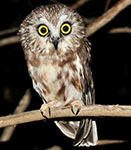 12/23 – Columbia County, HRM 124: I heard the call on my porch baby monitor at 4:35 AM, well before sunrise. It was a saw-whet owl. The owl called a few times, was quiet for a while, and then started up again. This was the first time I’d heard one near my yard in Austerlitz. Maybe the owl was attracted to feeder seed spilled on the ground. (Photo of saw-whet owl courtesy of Scott Summershoe) 12/23 – Columbia County, HRM 124: I heard the call on my porch baby monitor at 4:35 AM, well before sunrise. It was a saw-whet owl. The owl called a few times, was quiet for a while, and then started up again. This was the first time I’d heard one near my yard in Austerlitz. Maybe the owl was attracted to feeder seed spilled on the ground. (Photo of saw-whet owl courtesy of Scott Summershoe)
– Nancy Kern
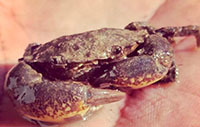 12/23– Manhattan, HRM 1: We enjoyed the warm sun while checking The River Project’s collection and sampling gear on the steamship Lilac, moored at Pier 25 in Hudson River Park. We encountered the usual arrangement of invertebrates: isopods, amphipods, shore shrimp, sand shrimp, mud dog whelks, and mud crabs, with one particularly large and photogenic male mud crab that was rather cross with us for disturbing him. (Photo of mud crab courtesy of Melissa Rex) 12/23– Manhattan, HRM 1: We enjoyed the warm sun while checking The River Project’s collection and sampling gear on the steamship Lilac, moored at Pier 25 in Hudson River Park. We encountered the usual arrangement of invertebrates: isopods, amphipods, shore shrimp, sand shrimp, mud dog whelks, and mud crabs, with one particularly large and photogenic male mud crab that was rather cross with us for disturbing him. (Photo of mud crab courtesy of Melissa Rex)
-Siddhartha Hayes, Melissa Rex
12/24 – Norrie Point, HRM 85: After a week of well below freezing air temperatures, we hit a day in the 40’s, and the common mergansers were taking advantage of it. The border of thin ice on the cove at Norrie Point was patrolled by five male common mergansers. They would dive in a tight arc, and when they popped up again, the water would stream off their heads and backs in quicksilver droplets. Their fishing behavior was a positive sign that the river is alive both above and below the surface.
– Chris Bowser
12/25 – Washington County, HRM 200: I spotted a greater white-fronted goose (Anser albifronson) at the outlet of Cossayuna Lake where the outlet crosses the road in the hamlet of Cossayuna. Rounding out the sighting was a pair of river otters (Lontra canadensis) near a hole in the ice.
– Scott Varney (Hudson-Mohawk Birds)
12/25 –Millbrook, HRM 82: It appears that my local predators may organize themselves around coyotes. As documented by my trail cameras, each spring and summer, a pair of coyotes raises a family on or near my property. They often leave in the fall and, within a few months, foxes and/or bobcats take their place. The coyotes eventually return, the foxes and bobcats vanish, and the cycle begins again. My speculation is that foxes and bobcats are absent during spring and summer to avoid the coyotes; the coyotes leave in the fall because their fall food is more abundant elsewhere, and good hunting niches are rare enough (and predators abundant enough) that foxes and bobcats quickly find and occupy niches vacated by coyotes.
– Nelson Johnson
12/26 – Staten Island, New York City: We had a brown pelican fly directly over us around noon today while standing on the rock jetty near the base of the Verrazano Narrows Bridge at Fort Wadsworth. It circled once and then continued under the bridge and was last seen heading in the general direction of the Staten Island Ferry terminal. There were loads of fish in Raritan Bay today with striped bass feeding on menhaden close offshore and a few dozen harbor seals getting into the mix as well.
– Michael Shanley III
12/27 – Newcomb, HRM 300: The Hudson River near its headwaters has been freezing, then thawing, then freezing again. We certainly could use some more snow to help the river make up its mind.
– Dave Olbert, Ruth Olbert
12/27 – Brooklyn, New York City: The light was still low, and the sky overcast early this morning as I took a driving tour of the grasslands project at Floyd Bennett Field. It really seemed like one of those “not a creature was stirring” mornings. The world was still in the thrall of the holiday season, and few people had ventured into work. Then, a dark lump, sitting motionless on a small rise, captured my attention. I hoped it would be one of the increasingly rare short-eared owls within New York City limits as I fished out my binoculars. No short-eared owl, but a very somber-looking peregrine falcon filled the lens, likely on some kind of kill from the gravity of its gaze.
– Dave Taft
12/28 – Croton Bay, HRM 34: For the last few weeks, I have been seeing what I thought might be buffleheads [ducks] as I took the train to the city in the morning, but they were always far away. Today, we went down to the station to take a better look and found nearly a dozen, both drake and hen buffleheads, in a small raft swimming around. The males have huge white crests while the hens have white cheeks. They are one of our favorite “winter ducks” that come here from their northern breeding areas in order to find open water.
– Hugh McLean, Annie McLean
12/28 – Ulster-Dutchess counties: We conducted our ninth annual Ulster/Dutchess (NYUD) Christmas Bird Count today. There was absolutely no breeze throughout the day which did keep a veil of fog in locations along the river making viewing difficult. Black ice was reported in most sectors, and the snow cover that was present had a slippery crust making early birding a bit treacherous. The Hudson River was open and mirror-like, while its main tributaries ran freely. Smaller bodies of water were frozen with shaded and protected areas still holding on to an inch or two of several-week-old snow.
Forty-five birders in 13 field parties, plus two feeder watchers, covered the circle’s ten sectors. They documented 79 species totaling 14,731 individual birds. The species total represented our second lowest (78 in 2013) and the individual count was the third lowest we’ve tallied. After nine years, our bird count composite list stands at 128 species with no new additions this year. Through nine years we have averaged 85 species and 17,470 individuals on count day.
Highlights included long-eared owl, blue-winged teal, and rusty blackbirds, gray catbird, eastern towhee, northern saw-whet owl, purple finches and a house wren. There may have been a first with three different sectors observing red-headed woodpeckers. Another unique occurrence was the 42 individual owls counted in five sectors.
Thirteen species set high counts this year, including red-bellied woodpecker, common loons, swamp sparrows, and Carolina wrens. Six species set new low counts this year, including black-capped chickadee, tufted titmouse, and dark-eyed junco.
– Mark DeDea, Steve Chorvas
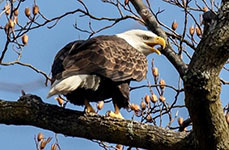 12/29 – Town of Poughkeepsie: Bald eagle nest NY62 has been sitting near the crown of a tall tulip tree since 2011. In recent days, the adults have been revving up their preparations for their 2020 season amidst the huge and gorgeous tulip buds that are prepared to pop out in the warmth of springtime. (Photo of NY62 bald eagle nest courtesy of Bob Rightmyer) 12/29 – Town of Poughkeepsie: Bald eagle nest NY62 has been sitting near the crown of a tall tulip tree since 2011. In recent days, the adults have been revving up their preparations for their 2020 season amidst the huge and gorgeous tulip buds that are prepared to pop out in the warmth of springtime. (Photo of NY62 bald eagle nest courtesy of Bob Rightmyer)
– Bob Rightmyer
12/30 – Newcomb, HRM 302: The month of December resulted in just over 19-inches of snowfall, about four-inches below our average for the month. The number of birds at the feeders seemed rather meager this winter until we received a half-inch of ice yesterday and an additional few inches of snow. There was a flock of forty American goldfinches at the feeder today, along with the usual blue jays, nuthatches, downy and hairy woodpeckers, black-capped chickadees and a few American tree sparrows and white-crowned sparrows. There is a good seed crop to the north, so we likely will not see the more irruptive winter finch bird species such as evening grosbeaks, pine siskins or common redpolls.
– Charlotte Demers
12/31 – Saratoga County, HRM 157: In early afternoon, I drove a half-mile down the Mohawk River from Klamsteam Tavern to the Crescent Bridge where the shallow water was frozen. A small raft of common mergansers was near the marina at the halfway point. The next birds I saw was a group of gulls, mostly great black-backed gulls (29), floating down the river, some riding atop small ice chunks like royalty. Herring (19) and ring-billed gulls (25) were mixed in, hanging out on the edge of the ice, but the highlight was an Iceland gull (Larus glaucoides).
– Ron Harrower
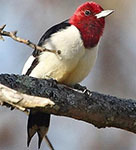 1/1 – Norrie Point, HRM 85: I heard their very vocal calls before I saw them: two red-headed woodpeckers around the docks in midday at Norrie Point Marina. One of them, at the Kayak Station, appeared to be an immature but the second one, across the road, was clearly an adult. Neither bird was moving much, and they did not appear to be working on acorns. I returned from my walk an hour later and heard them calling from deeper in the woods. (Photo of red-headed woodpecker courtesy of Jake Dingal) 1/1 – Norrie Point, HRM 85: I heard their very vocal calls before I saw them: two red-headed woodpeckers around the docks in midday at Norrie Point Marina. One of them, at the Kayak Station, appeared to be an immature but the second one, across the road, was clearly an adult. Neither bird was moving much, and they did not appear to be working on acorns. I returned from my walk an hour later and heard them calling from deeper in the woods. (Photo of red-headed woodpecker courtesy of Jake Dingal)
– Frank Margiotta
1/2 – Manhattan, HRM 1: For the first time in 2020, we checked our research gear at The River Project’s sampling station on the lighthouse tender Lilac moored at Pier 25 in Hudson River Park. There, we found sluggish isopods, mud dog whelks, and shore shrimp huddling in the fish traps.
– Toland Kister, Siddhartha Hayes
1/3 – Hudson River Watershed: The third New York State Breeding Bird Atlas has officially begun. We hope that you will join thousands of other birders in documenting the state’s breeding species over the next five years. The New York Breeding Bird Atlas III website (https://ebird.org/atlasny/about) contains a lot of great information about the Atlas, and we encourage you to explore the many resources on the site.
– Wendy Tocci, Anne Swaim
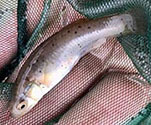 1/3 – Yonkers, HRM 18: We took advantage of a quiet day to go seining in the calm and ever foggy river this morning. To our surprise, we caught a turtle, a juvenile red-eared slider (Trachemys scripta elegans). The highlight, however, was a surprising winter-caught mummichog. The salinity was 4.5 parts-per-thousand (ppt), and the water temperature was 35 degrees F. (Photo of mummichog courtesy of Elisa Caref) 1/3 – Yonkers, HRM 18: We took advantage of a quiet day to go seining in the calm and ever foggy river this morning. To our surprise, we caught a turtle, a juvenile red-eared slider (Trachemys scripta elegans). The highlight, however, was a surprising winter-caught mummichog. The salinity was 4.5 parts-per-thousand (ppt), and the water temperature was 35 degrees F. (Photo of mummichog courtesy of Elisa Caref)
– Katie Lamboy, Elisa Caref
|

