A Project of the Hudson River Estuary Program
Compiled and edited by Tom Lake, Consulting Naturalist
Love Our NY Lands
State Lands Belong to All of Us
All New Yorkers and visitors should be able to access, enjoy, and feel welcome on state lands. These lands belong to all of us, our families, and our neighbors. While enjoying these shared spaces, be respectful of other visitors. Share trails, treat people with kindness, and leave things as you found them for others to enjoy. All of us have a responsibility to protect State lands for future generations. For more information, visit: https://www.dec.ny.gov/outdoor/119881.html
Overview
This was a week that brimmed with highlights. The winner of the coin flip is below. Others include a rarely sighted warbler, an eel life stage almost never seen in the estuary, and the annual end-of-may small goose migration. Seal sightings are recurring, perhaps our Saugerties seal, and monarch butterflies have begun to brighten our already colorful wildflowers. Bald eagles nestlings were getting very anxious.
Highlight of the Week
 5/20 – Manhattan, HRM 2: Our Hudson River Park’s River Project staff checked our sampling and collection gear that we deploy off Pier 40 in Hudson River Park. Our first stop was our umbrella trap, set off the south side of Pier 40, where I was surprised to find a distinct splash of color among the regular retinue of grass and sand shrimp. It was a small shrimp, 30 millimeters (mm) with brilliant red lines across its exoskeleton, that had found its way into our trap. 5/20 – Manhattan, HRM 2: Our Hudson River Park’s River Project staff checked our sampling and collection gear that we deploy off Pier 40 in Hudson River Park. Our first stop was our umbrella trap, set off the south side of Pier 40, where I was surprised to find a distinct splash of color among the regular retinue of grass and sand shrimp. It was a small shrimp, 30 millimeters (mm) with brilliant red lines across its exoskeleton, that had found its way into our trap.
We consulted with several shrimp identification experts leading us to conclude this was Lysmata vittata, an east Asian lined shrimp, also one of several species in the genus colloquially referred to as peppermint shrimp. They were introduced from the Indo-Pacific region and has had previous sightings in Chesapeake Bay as well as in Long Island Sound near Norwalk. (Photo of peppermint shrimp courtesy of Toland Kister)
– Toland Kister
[“Lysmata vittata is generally semitransparent with numerous fine red longitudinal striae [lines]” Bruce (1986). In aquiculture, they are classified as a species of “cleaner shrimp,” removing parasites from the orange-spotted grouper (Epinephelus coioides), among others. L. vittata is a species complex that is still being teased out, so there may be more identification work to be done. I have prepared a specimen of this individual to aid in this task. Toland Kister]
[Note: One-inch equals 25.4 mm].
Natural History Entries
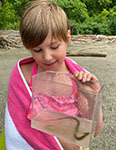
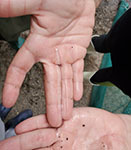 5/20 – Rockland County, HRM 31: We were on the beach at Nyack Beach State Park today with local 4th grade elementary school students. The program had been organized by the Outdoor Science Alliance. Our seining station was staffed by high-school leaders who hauled the net. Among the fish we caught were Atlantic tomcod and juvenile striped bass. Most of our catch, however, was comb jellies. Near midday, a haul came up on the beach with a fish we had not seen before. It was long, thin, translucent, had the look of an eel, and it was alive! Through DEC’s Sarah Mount, we sent the unknown fish to Bob Schmidt for identification at the New York State Museum in Albany. (Photo of leptocephali courtesy of Briana Rosamilia) 5/20 – Rockland County, HRM 31: We were on the beach at Nyack Beach State Park today with local 4th grade elementary school students. The program had been organized by the Outdoor Science Alliance. Our seining station was staffed by high-school leaders who hauled the net. Among the fish we caught were Atlantic tomcod and juvenile striped bass. Most of our catch, however, was comb jellies. Near midday, a haul came up on the beach with a fish we had not seen before. It was long, thin, translucent, had the look of an eel, and it was alive! Through DEC’s Sarah Mount, we sent the unknown fish to Bob Schmidt for identification at the New York State Museum in Albany. (Photo of leptocephali courtesy of Briana Rosamilia)
– Brianna Rosamilia, Sarah Mount
After some analysis, I concluded that it was a conger eel leptocephali (Conger oceanicus), measuring 110 mm. As adults, conger eels are found in the Atlantic from Cape Cod to northern Florida as well as the Gulf of Mexico. They can reach seven-feet-long and weigh 88 pounds. Physically, they are very similar to, and are often confused with, American eels. Bob Schmidt]
[Leptocephalus is from the Greek Leptos, and cephalo, together meaning thin head. They are the flat and near transparent larva of several eel–like fishes in the estuary including the American eel, conger eel, snake eel, and others. However, the length of this leptocephali only fits the conger eel. All others are far shorter. Conger eels are found in coastal and estuarine waters from Nova Scotia to Chesapeake Bay. In northern latitudes, they make their way inshore and sometimes are found washed up on beaches. Their minimum salinity requirement in estuarine waters varies from 3.0 to 19.0 parts-per-thousand (ppt). (J.D. Hardy Jr.1978). Tom Lake]
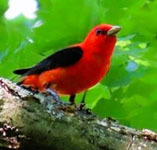 5/20 – Piermont, HRM 25: I walked out on Piermont Pier on a recent morning to do some peak migration birding. I logged 52 species across two hours. Highlights were 13 species of warblers, including ovenbird, northern waterthrush, black-and-white, common yellowthroat, American redstart, northern parula, yellow-rumped, magnolia, yellow warbler, black-throated blue, black-throated green, chestnut-sided, and prairie warbler. Other birds included veery, least sandpiper, 12 savannah sparrows, and a single lingering ruddy duck. My most surprising sighting, however, was a fleeting look at a muskrat swimming in the drainage channel between the condominiums and Ferry Road. I hadn’t seen one in many years and. for some reason I can’t explain, I just love muskrats! (Photo of scarlet tanager courtesy of Cynthia Edwardson) 5/20 – Piermont, HRM 25: I walked out on Piermont Pier on a recent morning to do some peak migration birding. I logged 52 species across two hours. Highlights were 13 species of warblers, including ovenbird, northern waterthrush, black-and-white, common yellowthroat, American redstart, northern parula, yellow-rumped, magnolia, yellow warbler, black-throated blue, black-throated green, chestnut-sided, and prairie warbler. Other birds included veery, least sandpiper, 12 savannah sparrows, and a single lingering ruddy duck. My most surprising sighting, however, was a fleeting look at a muskrat swimming in the drainage channel between the condominiums and Ferry Road. I hadn’t seen one in many years and. for some reason I can’t explain, I just love muskrats! (Photo of scarlet tanager courtesy of Cynthia Edwardson)
– Linda Pistolesi
5/21 – Albany County, HRM 153: We counted four flyover common nighthawks at dusk in Colonie; shortly thereafter, seven more passed over.
– Tom Williams, Colleen Williams (Hudson-Mohawk Bird Club)
[The common nighthawk (Chordeiles minor), a medium-sized crepuscular or nocturnal bird, is a New York State species of Special Concern. They are a member of the nightjar family (Caprimulgidae) whose presence and identity are best revealed by its vocalization as well as its erratic flight and distinctively angular wings as it flies to catch insects. Rich Guthrie, Deborah Tracy Kral]
5/21 – Albany, HRM 145: The air temperature today reached 91 degrees Fahrenheit (F), one degree shy of the record high for the date.
– National Weather Service
 5/21 – Little Stony Point, HRM 55: We gathered on the beach in midday for our contribution to the 5th World Fish Migration Day. This was also a day when the air temperature on the beach would peak at 92 degrees F, although the water was very comfortable for wading at 62 degrees F. 5/21 – Little Stony Point, HRM 55: We gathered on the beach in midday for our contribution to the 5th World Fish Migration Day. This was also a day when the air temperature on the beach would peak at 92 degrees F, although the water was very comfortable for wading at 62 degrees F.
We caught five fish species across ten hauls of our seine, two which were migrants heading to the sea. Yearling striped bass (70-82 mm), the class of 2021, would be heading seaward this summer for several years of maturing before returning as adults to participate in spawning. Top count in the net went to young-of-year alewives, or river herring. We measured and released hundreds (29-36 mm). Those that make the trek to the sea will return in spring about four years as adults to participate in spawning.
The other fish were resident species, including dozens of spottail shiners, several of which were gravid females (130 mm), white perch, and young-of-year (YOY) bluegill sunfish (31 mm). (Photo of Atlantic tomcod courtesy of Tom Lake)
– Tom Lake, T.R. Jackson, B.J. Jackson
[World Fish Migration Day is a global celebration every other year to raise global attention to the importance of free-flowing rivers for migratory fish and to encourage healthier fish stocks. Organizations from around the world coordinate their own events with a common theme of connecting, fish, rivers, and people. The day begins in New Zealand and follows the sun ending in Hawaii. NOAA]
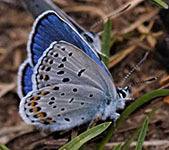 5/22 – Albany, HRM 150: I took a walk today on Albany’s one-mile Pine Bush Preserve loop trail and saw hundreds of the rare Karner blue butterflies (Lycaeides Melissa samuelis). They are named after the hamlet of Karner in the nearby town of Colonie. Karner blues are the size of a dime and today they were flitting along the sandy Preserve trails collecting minerals. 5/22 – Albany, HRM 150: I took a walk today on Albany’s one-mile Pine Bush Preserve loop trail and saw hundreds of the rare Karner blue butterflies (Lycaeides Melissa samuelis). They are named after the hamlet of Karner in the nearby town of Colonie. Karner blues are the size of a dime and today they were flitting along the sandy Preserve trails collecting minerals.
The Pine Bush Preserve in Albany is a sandy ecosystem that is the remnant of the proglacial Lake Albany that formed during the end of the Wisconsinan glaciation 15,000 years ago. Today its sandy hills are one of the remaining habitats for the rare Karner blue. The Preserve flyer reminds us that they are an “Endangered Species in a Globally Rare, Nationally Significant, and Locally Distinct Ecosystem.”
This species has been rebounding in the past several years due to this wonderful Preserve. Restoration efforts include controlled burns and the abundance of wild lupines–they lay their eggs on the leaves–that are the sustaining flora of the Karner blue. Unlike the monarch, this butterfly does not migrate; during its entire life cycle, it may range less than 700 feet. (Photo of Karner blue butterfly courtesy of Mario Meier)
– Mario Meier
5/22 – Columbia County, HRM 113: We spotted a monarch butterfly in our yard this morning. It was a very dark and large individual flying around and alighting on several milkweeds. The milkweed, of course, does not have flowers this early in the season, so there was no nectar for the butterfly. After 20 minutes it flew off to parts unknown.
– Bob Schmidt, Kathy Schmidt
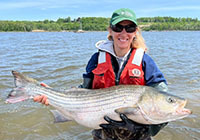 5/23 – Coxsackie, HRM 124: Our DEC Region 3 Hudson River Fisheries Unit spotted a seal in the river today as we were haul seining (500-foot net) for our spawning stock survey. We had just begun processing our catch when Kelsey Gustafson spotted the seal in the water. It bobbed around our area watching us until it had enough, and then disappeared. (Photo of striped bass courtesy of Amanda Higgs) 5/23 – Coxsackie, HRM 124: Our DEC Region 3 Hudson River Fisheries Unit spotted a seal in the river today as we were haul seining (500-foot net) for our spawning stock survey. We had just begun processing our catch when Kelsey Gustafson spotted the seal in the water. It bobbed around our area watching us until it had enough, and then disappeared. (Photo of striped bass courtesy of Amanda Higgs)
– Jess Best, Amanda Higgs, Gregg Kenney, Kelsey Gustafson, Sarah LaLumiere, Kristyn Gessner, Todd Padilla, Billy Benedict, Elizabeth Streifender
5/23 – Town of Wappinger, HRM 67: The increased foliage, on and around the nest tree for bald eagle nest NY459. had made it very difficult to see inside. I finally found a spot today where I was able to see one nestling. As I watched, one of the adults flew up into the crown of the tree.
– Judy Winter
[In their first three breeding seasons, 2019-2021, the adult pair at NY459 have had six nestlings. If all continues to go well, we expect a fledge between June 21 and July 9. Judy Winter]
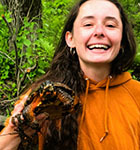 5/23 – Putnam County: Today was World Turtle Day so it was quite appropriate that I’d find one. On this occasion, it was my species of interest, a wood turtle (Glyptemys insculpta). The turtle was sitting on the gravely bottom of a quick moving creek in Putnam County. It must have just eaten a slug as it had remnants of the sticky invertebrate on its mouth. It was a male turtle that I estimated to be about 15 years old. (Photo of wood turtle courtesy of Lauren Martin) 5/23 – Putnam County: Today was World Turtle Day so it was quite appropriate that I’d find one. On this occasion, it was my species of interest, a wood turtle (Glyptemys insculpta). The turtle was sitting on the gravely bottom of a quick moving creek in Putnam County. It must have just eaten a slug as it had remnants of the sticky invertebrate on its mouth. It was a male turtle that I estimated to be about 15 years old. (Photo of wood turtle courtesy of Lauren Martin)
– Lauren Martin
[The American Tortoise Rescue is the founding sponsor of World Turtle Day, an annual observance that occurs every May 23 since 2000.The day was created as a yearly observance to help people celebrate and protect turtles and tortoises and their disappearing habitats around the world as well as to encourage human action to help them survive and thrive. Wendy Heller, 2008]
5/23 – Yonkers, HRM 18: The staff for the Sarah Lawrence Center for the Urban River at Beczak made nine hauls of our seine today with the assistance of 3rd graders from the Ethical Culture Fieldston School. We caught a good variety of fish and invertebrates. Among them were American eels, Atlantic tomcod (5), mummichogs, white perch, blue crabs (14), grass shrimp (45), and a Leidy’s comb jelly. The river temperature was 63 degrees F, the salinity was 8.0 ppt, and the dissolved oxygen was 9.1 parts-per-million (ppm).
– Christina Edsall, Katie Lamboy, Jason Muller
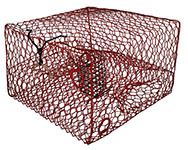 5/23 – Manhattan, HRM 1-2: Our Hudson River Park’s River Project staff checked the sampling and collection gear that we deploy off Pier 40 in Hudson River Park. Today we celebrated a full catch of five adult tautog-blackfish (250-460 mm) spread between two crab pots. Our perusal of the River Project fish ecology data since 2018, suggests that the larger tautog was one of the largest blackfish we have caught in a trap, if not the longest in recent memory. Also in the Pier 40 traps were three juvenile black sea bass (55-85 mm) in addition to several grass shrimp and mud crabs. At Pier 26, our crab pot caught an oyster toadfish (200 mm) and a variety of invertebrates including grass shrimp, mud crabs, mud dog whelks (notably plentiful), and blue mussels. (Photo of blue crab pot courtesy of Tom Lake) 5/23 – Manhattan, HRM 1-2: Our Hudson River Park’s River Project staff checked the sampling and collection gear that we deploy off Pier 40 in Hudson River Park. Today we celebrated a full catch of five adult tautog-blackfish (250-460 mm) spread between two crab pots. Our perusal of the River Project fish ecology data since 2018, suggests that the larger tautog was one of the largest blackfish we have caught in a trap, if not the longest in recent memory. Also in the Pier 40 traps were three juvenile black sea bass (55-85 mm) in addition to several grass shrimp and mud crabs. At Pier 26, our crab pot caught an oyster toadfish (200 mm) and a variety of invertebrates including grass shrimp, mud crabs, mud dog whelks (notably plentiful), and blue mussels. (Photo of blue crab pot courtesy of Tom Lake)
– Zoe Kim
[The basic design of the crab pot (24 x 24 x 19-inches) was developed in 1920. In the100+ years since, its basic design has endured–no others have surpassed it in efficiency. They are the standard for crabbers from New England to the Chesapeake to the Gulf of Mexico. In the Hudson River, blue crabbers refer to them as an “overnight pot,” baited, set, retrieved later, often the next day. Tom Lake]
5/24 – Albany, HRM 145: Several hundred northbound brant headed up the Hudson River at the City of Albany waterfront today.
– Tristan Lowery
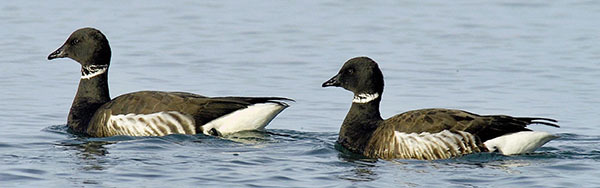
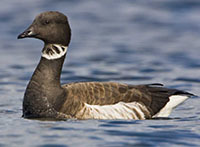 5/24 – Selkirk, HRM 135: A low-flying flock of about 80 brant just flew north, following the river, over my place in Selkirk. (Photo of brant courtesy of Doug Wechsler) 5/24 – Selkirk, HRM 135: A low-flying flock of about 80 brant just flew north, following the river, over my place in Selkirk. (Photo of brant courtesy of Doug Wechsler)
– John Kent
[Legendary waterman Dery Bennett used to mark the seasons by noting how brant (Branta bernicla), a small species of goose, left Sandy Hook, New Jersey, around Memorial Day after spending the winter, and headed north. In his words, “They would shove off for the Canadian Arctic where they breed, fledge young, and then return around Columbus Day.” Tom Lake]
5/24 – Annandale-on-Hudson, HRM 98.5: I visited the Saw Kill (Hudson River tributary) today. There were no alewives in the stream, and it seemed like they were finished for the season. Smallmouth bass were still there but their numbers were down. Yellow perch had made their appearance–some fraction of the population swims into tributaries to spawn. The rest of the fauna appeared to be transitioning into the early summer phase. I caught rock bass, bluegills, fallfish, and a striped bass. There was a hatch of small black caddisflies; I learned that these are Chimera caddis flies, which I have seen in the larval stage in this area of the Saw Kill.
– Bob Schmidt
 5/24 – Little Stony Point, HRM 55: Seining had been slow so far this spring on the beach at Little Stony Point, part of the Hudson Highlands State Park. However, when we got in the water today–the river was a very pleasant 65 degrees F–our expectations were buoyed by our first haul. As we landed the net up on the sand, hundreds of tiny, translucent, young-of-year alewives squeezed through the too-large mesh and wiggled their way back to the water. Tiny, young-of-the-season, quarter-size, blue crabs got hung up in the twine and had to be rescued. Ten-inch-long American eels hid in the folds of the net before slithering away to the river when we gave them the chance. But for us, the unexpected highlights were YOY bay anchovies and Atlantic tomcod. 5/24 – Little Stony Point, HRM 55: Seining had been slow so far this spring on the beach at Little Stony Point, part of the Hudson Highlands State Park. However, when we got in the water today–the river was a very pleasant 65 degrees F–our expectations were buoyed by our first haul. As we landed the net up on the sand, hundreds of tiny, translucent, young-of-year alewives squeezed through the too-large mesh and wiggled their way back to the water. Tiny, young-of-the-season, quarter-size, blue crabs got hung up in the twine and had to be rescued. Ten-inch-long American eels hid in the folds of the net before slithering away to the river when we gave them the chance. But for us, the unexpected highlights were YOY bay anchovies and Atlantic tomcod.
The origins of our catch were fascinating: The alewives (30-45 mm) were born six weeks earlier in one of the nearby tidal tributaries; the anchovies (70 mm) and the blue crabs had been born two months ago, 70 miles downriver; the tomcod (55 mm) were born in winter under the river’s ice; and the striped bass were yearlings, Hudson River Class of 2021. The resident fishes were also well-represented in spottail shiners and white perch. (Photo of American eel courtesy of Tom Lake)
– Tom Lake, Phyllis Lake, Loring Skerel, Ella Skerel, Ryder Skerel, Seth Dinitz, Ellie Dinitz
[The standard research measurement for blue crabs is laterally, point-to-point, across their carapace.]
5/24 – Croton-on-Hudson, HRM 34.5: As I was waiting for an early morning Metro North commuter train to Manhattan, I watched as an adult osprey brought a fish to its nest on the cell phone tower at the south end of the Croton-Harmon train station. This happened too far away for me to see what kind of fish. This month included my first post-COVID sightings (since 2019).
The osprey circled lazily around and landed on one of the tower’s lower struts, perhaps to take a break from the feeding frenzy in the nest. There has been an osprey nest on the cell tower since at least 2015–the same adults, or not, is unknown.
– Hugh McLean
5/24 – Bedford, HRM 35: The great blue heron rookery now had nine-nestlings visible. The nestlings were becoming more active and were beginning to exercise their wings. There were four adults present watching and tending to their young. I am sure that in the coming weeks more nestlings will become visible.
– Jim Steck
5/24 – Yonkers, HRM 18: The staff for the Sarah Lawrence Center for the Urban River at Beczak checked our fyke net that we had set overnight in the Beczak tidemarsh. Glass eels (8) were still showing up; invertebrates included grass shrimp, mud crabs, blue crabs, and a fiddler crab. The river temperature was 63 degrees F, the salinity was 8.8 ppt, and the dissolved oxygen was 8.8 ppm.
– Jason Muller
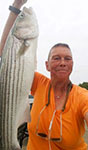 5/24 – Manhattan, HRM 13.5: In a late-afternoon high tide, I was rod and reel fishing with raw shrimp in the Harlem River off Inwood Park’s Dykeman Pier. Fishing was slow until I hooked a large striped bass, a 24-inch male, the biggest striped bass I had ever caught at Dyckman Pier, or anywhere else for that matter (my previous large striped bass, to that point, had been 10-inches). Earlier, I had caught a very small oyster toadfish and a short, skinny American eel. (Photo of striped bass courtesy of Nicola Lagonigro) 5/24 – Manhattan, HRM 13.5: In a late-afternoon high tide, I was rod and reel fishing with raw shrimp in the Harlem River off Inwood Park’s Dykeman Pier. Fishing was slow until I hooked a large striped bass, a 24-inch male, the biggest striped bass I had ever caught at Dyckman Pier, or anywhere else for that matter (my previous large striped bass, to that point, had been 10-inches). Earlier, I had caught a very small oyster toadfish and a short, skinny American eel. (Photo of striped bass courtesy of Nicola Lagonigro)
– Nicola Lagonigro
[The allowable slot size for creeling striped bass in the Hudson River above the George Washington Bridge is 18-28-inches, total length, and only two per day.]
5/25 – Yonkers, HRM 18: The staff for the Sarah Lawrence Center for the Urban River at Beczak made eight hauls of our seine today again with the assistance of 3rd graders from the Ethical Culture Fieldston School. Fish in our catch included American eels, northern pipefish, Atlantic tomcod, white perch, and a very special summer flounder (size of a quarter). Among invertebrates were blue crabs (20), grass shrimp (48), and a Leidy’s comb jelly.
Later, we also checked our fyke net that we had set overnight in the Beczak tidemarsh. Our target species, glass eels (American eels), failed to show. However, there were two YOY Atlantic herring, some grass shrimp, and amphipods. The river temperature was 63 degrees F, the salinity was 8.1 ppt, and the dissolved oxygen was 9.2 ppm.
– Jason Muller, Christina Edsall, Katie Lamboy – with Ethical Culture Fieldston School (3rd grade)
5/25 – Manhattan, HRM 1-2: Our Hudson River Park’s River Project staff checked our sampling and collection gear that we deploy off Piers 40 and 29 in Hudson River Park. Our crab pots caught an adult tautog-blackfish (345 mm) and an oyster toadfish (275 mm). The minnow traps caught an immature black sea bass (60 mm), and several invertebrates including grass shrimp, isopods, and a mud crab, the latter of which was missing one claw. Mud crabs, time permitting, can regenerate a lost appendage
At Pier 26, our crab pots caught two tautog-blackfish (295, 320 mm). Our minnow trap caught a YOY black sea bass (60 mm), in addition to some grass shrimp and many young mud dog whelks. This location in recent days has been flush with small mud dog whelk snails.
– Zoe Kim
*** Fish of the Week ***
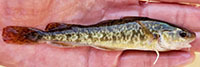
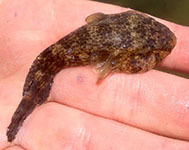 5/26 – Hudson River Watershed: Fish-of-the-Week for Week 174 is the skilletfish (Gobiesox strumosus), number 208 (of 236) on our watershed list of fishes. If you would like a copy of our list, e-mail – trlake7. 5/26 – Hudson River Watershed: Fish-of-the-Week for Week 174 is the skilletfish (Gobiesox strumosus), number 208 (of 236) on our watershed list of fishes. If you would like a copy of our list, e-mail – trlake7.
Skilletfish is the only member of its family of clingfishes (Gobiesocidae) documented for our watershed. They are a small benthos-loving fish related to gobies and blennies. Like gobies, they have a pelvic suction disc leading to their other common name, clingfish (Hildebrand and Schroeder 1928). In the Chesapeake, they are colloquially called oyster-clingers. Their common name comes from a dorsally flattened body with a large, roundish head that altogether looks like a skillet.
They are found from New York to Brazil inhabiting grassy and rocky shallow areas and around pilings where they range in size from 80-102 mm. In the Hudson River, they are considered a temperate marine stray in the lower, brackish reach of the estuary. Skilletfish find oyster reefs ideal habitat for spawning, forage, and safety–they spawn in empty oyster shells.
They are infrequently caught in the East River by the Brooklyn Bridge Park Conservancy as well as the Hudson River Park-River Project off Pier 40 in Manhattan. In times long past, when the estuary supported large and healthy oyster beds, skilletfish were likely more common. (Photo of skilltetfish courtesy of Melissa Rex)
– Tom Lake
5/26 – Yonkers, HRM 18: The staff for the Sarah Lawrence Center for the Urban River at Beczak checked our fyke net that we had set overnight in the Beczak tidemarsh. We caught three of our target species, glass eels (American eels). Also in the net were grass shrimp and mud crabs. The river temperature was 63 degrees F, the salinity was 8.5 ppt, and the dissolved oxygen was 8.6 ppm.
– Jason Muller
 5/27 – Westchester County, HRM 45: My grandson Max, age 20, is an excellent ear birder. We were walking together this morning on one of the back trails at Muscoot Farm when he said to me “Wait there’s a Kentucky warbler calling!” We heard it several more times and recorded it, but we did not get eyes on it. Then we put the word out and several other birders arrived. They were able to find the warbler and get good looks and photos. 5/27 – Westchester County, HRM 45: My grandson Max, age 20, is an excellent ear birder. We were walking together this morning on one of the back trails at Muscoot Farm when he said to me “Wait there’s a Kentucky warbler calling!” We heard it several more times and recorded it, but we did not get eyes on it. Then we put the word out and several other birders arrived. They were able to find the warbler and get good looks and photos.
In what seems unprecedented for Westchester County, at least three Kentucky warblers have now been seen in last ten days. They certainly appear to be different birds since they have been documented at significantly distant points across the county. (Photo of Kentucky warbler courtesy of Steve Rappaport)
– Larry Trachtenberg, Max Kogut, Steve Rappaport
[The Kentucky warbler is a shy bird of deciduous forest with thick understory. They are bright yellow below with and olive back, have a telltale black mask set off by yellow spectacles and throat, and are often found in swampy areas or near slow-moving streams. In the breeding season, they are more often heard than seen. They range from the southeast U.S., west to Texas, and throughout the Caribbean, Central and northern South America. They winter within that range throughout the southwest and Central America. eBird]
5/27 – Yonkers, HRM 18: The staff for the Sarah Lawrence Center for the Urban River at Beczak checked our fyke net that we had set overnight in the Beczak tidemarsh. Our target species, glass eels (American eels), failed to show. However, there were blue crabs and mud crabs. The river temperature was 64 degrees F, the salinity was 10.0 ppt, and the dissolved oxygen was 8.6 ppm.
– Jason Muller
5/27 – Manhattan, HRM 1-2: Our Hudson River Park’s River Project staff checked our sampling and collection gear that we deploy off Pier 29 and 40 in Hudson River Park. On a hot and humid day, one of our crab pots yielded a magnificent oyster toadfish (225 mm). Our minnow traps caught grass shrimp, mud crabs, and mud dog whelks. At Pier 26, we found an abundant catch of grass shrimp, mud dog whelks–many clearly juvenile and some at the size we expect from a mature snail.
– Zoe Kim
Spring 2022 Natural History Programs and Events
June 11: Come out fishing for World Fish Migration Day
Come out for family-friendly and free fishing programs around the lower Hudson and NY Harbor. Multiple sites will be celebrating World Fish Migration Day at various times on June 11 with seining (netting) and angling activities. Confirmed sites include:
• Hudson River Field Station, Piermont Pier (Lamont Doherty Earth Observatory of Columbia Climate School)
• Fort Washington Park at 172nd Street, Manhattan (Clearwater) 12:30-2:30 pm
• Randall’s Island, North of 103rd St. Bridge, Manhattan (Randall’s Island Park Alliance) 10:30-12:00 pm
• Sarah Lawrence Center for the Urban River at Beczak, Yonkers (Beczak) 10:00-12:00 pm
• Lemon Creek Park, Seguine Avenue, Staten Island (NYSDEC) 1:00-2:30pm
Announcing the 2022 Hudson River Striped Bass Cooperative Angler Program
You can share your fishing trip information and help biologists understand and manage our Hudson River striped bass fishery. Here’s how it works: Fill out a logbook provided by us whenever you fish on the Hudson River (by boat or from shore). You can also use our survey123 app and record your trips using a smart phone or computer. Record general location, time, gear used, what you caught (or if you didn’t catch anything) and return the logbook when you are done fishing for the season. You’ll receive an annual newsletter summarizing the information in addition to the latest news regarding regulations and the river. Whether you catch-and-release or take home a keeper, you can be part of the Cooperative Angler Program. Online logbook instructions can be found here: https://www.dec.ny.gov/docs/remediation_hudson_pdf/hrcoopanglerelogbook.pdf
Join today by contacting: hudsonangler or call 845-256-3009
Hudson River Education
Teachers and students will enjoy our new Hudson River K-12 Unit of Study. This carefully curated group of lesson plans, arranged by topic and/or grade, brings together great learning tools developed by the DEC and dozens of estuary partners:
https://www.dec.ny.gov/education/25386.html
Hudson River Miles
The Hudson is measured north from Hudson River Mile 0 at the Battery at the southern tip of Manhattan. The George Washington Bridge is at HRM 12, the Tappan Zee 28, Bear Mountain 47, Beacon-Newburgh 62, Mid-Hudson 75, Kingston-Rhinecliff 95, Rip Van Winkle 114, and the Federal Dam at Troy, the head of tidewater, at 153. The tidal section of the Hudson constitutes a bit less than half the total distance – 315 miles – from Lake Tear of the Clouds to the Battery. Entries from points east and west in the watershed reference the corresponding river mile on the mainstem.
To Contribute Your Observations or to Subscribe
The Hudson River Almanac is compiled and edited by Tom Lake and emailed weekly by DEC’s Hudson River Estuary Program. Share your observations by e-mailing them to trlake7. To subscribe to the Almanac (or to unsubscribe), use the links on DEC’s Hudson River Almanac or DEC Delivers web pages.
Useful Links
National Oceanic and Atmospheric Administration online tide and tidal current predictions are invaluable when planning Hudson River field trips. For real-time information on Hudson River tides, weather and water conditions from sixteen monitoring stations, visit the Hudson River Environmental Conditions Observing System website.
DEC’s Smartphone app for iPhone and Android is now available at: New York Fishing, Hunting & Wildlife App. |




