A Project of the Hudson River Estuary Program
Compiled by Tom Lake, Consulting Naturalist
While enjoying outdoor spaces, please continue to follow the CDC/NYSDOH guidelines for preventing the spread of colds, flu, and COVID-19. To find out more about enjoying DEC lands and New York’s State Parks, visit DEC’s website #Recreate Local; https://www.dec.ny.gov/outdoor/119881.html
Keep at least six (6) feet of distance between you and others.
Wear a cloth face covering in public settings where social distancing measures are difficult to maintain.
Avoid close contact, such as shaking hands, hugging, and kissing.
Wash hands often or use a hand sanitizer when soap and water are not available.
Avoid surfaces that are touched often, such as doorknobs, handrails, and playground equipment.
DEC recommends avoiding busy trailheads. Find the trails less traveled and visit when trails may not be as busy during daylight hours.
Overview
The week was highlighted by the ongoing return of orioles, hummingbirds, warblers, grosbeaks, flycatchers, and other birds that had wintered far to the south. Herons, owls, and eagles were all tending to their nestlings. The upriver harbor seal had reached a nine-month residency, and flowering dogwood lit up the forests.
Highlight of the Week
 5/3 – Manhattan, HRM 1: For the first time since New York City went on PAUSE (March 22), we felt compelled to check The River Project’s research, sampling and collection gear on the lighthouse tender Lilac moored at Pier 25. 5/3 – Manhattan, HRM 1: For the first time since New York City went on PAUSE (March 22), we felt compelled to check The River Project’s research, sampling and collection gear on the lighthouse tender Lilac moored at Pier 25.
Normally, we empty the traps and pots and record catches at least once a week, up to five times a week in summer. However, after reviewing our last few years of data and noting that we’ve historically caught, at most, one or two fish in April, we decided to prioritize the health of our staff and the public by staying home as long as possible. But as temperatures rose, we felt it was important for the safety of any animals that might be in our gear to empty and take the traps and pots out of the water until The River Project and Hudson River Park staff could resume normal schedules. The last fish we caught prior to today was a young-of-year striped bass on December 18, so we were eager to see what six weeks had brought us.
Donning masks and gloves, we (Yossi, my quarantine partner, and I) boarded the Lilac to empty and remove the 20 killifish traps and four crab pots that comprise our Aquatic Animal Survey collection gear. Our catch included an 80 millimeter (mm) juvenile blackfish (tautog), eleven adult blackfish (250-300 mm), and two blackfish (about 350 mm) that fell out of a crab pot before they could be measured. One lined seahorse (80 mm) was hanging onto the potwarp. We also found the usual invertebrates, including shore shrimp, isopods, mud dog whelks, mud crabs, and some small (10-20 mm) blue crabs. We were pleased to see that all of the animals looked healthy and uninjured. (Photo of tautog courtesy of Melissa Rex)
– Melissa Rex, Yossi Rex
(1 inch = 25.4 millimeters)
[We know that fish have escaped from our collection gear before and wondered if animals have been entering and leaving the traps and pots throughout the last few weeks. Blackfish are highly associated with underwater structures and may intentionally use crab pots as habitat. We hope to use a GoPro video camera to monitor our traps in the future to learn if this is true, or just the hopeful musings of a guilty ecologist. Melissa Rex]
Natural History Entries
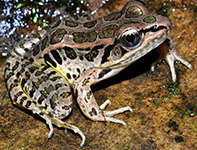 5/2 – Minerva HRM 284: I headed out to the pond in the woods in the “back forty” in midday. The spring peepers were out doing their peeping thing. There was also the unmistakable sound of a pickerel frog mixed in (a hoarse, grinding burr). I’m waiting for the mink frogs to make an appearance as well. In the woods, an eastern phoebe and winter wren were singing. Some early spring wildflowers were in bloom, including blue cohosh, wild oats, and Carolina spring beauty. Soon, purple trillium and toothwort will bloom. Our last pile of snow on the roof melted away today. (Photo of pickerel frog courtesy of Mike Corey) 5/2 – Minerva HRM 284: I headed out to the pond in the woods in the “back forty” in midday. The spring peepers were out doing their peeping thing. There was also the unmistakable sound of a pickerel frog mixed in (a hoarse, grinding burr). I’m waiting for the mink frogs to make an appearance as well. In the woods, an eastern phoebe and winter wren were singing. Some early spring wildflowers were in bloom, including blue cohosh, wild oats, and Carolina spring beauty. Soon, purple trillium and toothwort will bloom. Our last pile of snow on the roof melted away today. (Photo of pickerel frog courtesy of Mike Corey)
– Mike Corey
5/2 – Town of Catskill, HR 113: In mid-morning in Palenville, an immature golden eagle rode a rising thermal before jumping off and heading north.
– Larry Federman
5/2 – New Hamburg, HRM 67.5: Our first ruby-throated hummingbird (male) and a rose-breasted grosbeak (male) showed up today adding both color and grace to our feeders. The American goldfinches have been abundant; I cannot seem to keep the feeders filled.
– Kim Simons
[The first hummingbirds we see in late April and early May are not necessarily those that will spend the summer with us. As hummingbirds migrate upriver to more northern breeding areas, they stop at our feeders grateful for the supplement to the new spring flowers. Tom Lake]
5/2 – Hook Mountain, HRM 31: We counted 194 migrating raptors today at the Hook Mountain Hawkwatch. Broad-winged hawk led with 174 (90%). The conventional wisdom at Hook Mountain for the last three decades has been that there would not be any flights after the end of April. This year we were determined to see if that was true. The Bentsen Rio Grande Valley State Park Hawk Watch in Texas had 24,000 broad-winged hawks April 10, then 3,933 on April 14, and finally 1,540 on April 19. Since it takes roughly three weeks for them to get here, we thought we would continue the watch until May 15, or until there are no more migrants to be seen. Non migrants counted were bald eagle (12), red-tailed hawk (2), peregrine falcon (1), turkey vulture (2), and black vulture (3). One high-flying bald eagle was carrying what looked like a snake.
– Ajit I. Antony, Liza Antony
5/3 – Saugerties, HRM 102: The osprey on light tower #93 were on eggs, incubating. Since they returned on March 23, they had refurbished the nest. Returning blue jays have been crossing the river each day in small flocks. They perch for a while in a maple tree at our dock before launching out for their river crossing.
– Patrick Landewe
5/3 – Greene County: On a sunny but blustery day, we paddled near the new incarnation of bald eagle NY203, a few hundred yards from the original nest. We saw two adult eagles on the rim of the nest, appearing to interact with a nestling (or two) hidden down inside. Two other eagles soared high above.
– Kaare Christian
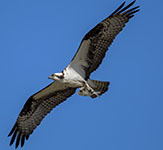 5/3 – Port Ewen, HRM 92: The presence of osprey fishing in the river has become a common sighting. I watched today as an osprey decided to snatch a gizzard shad out of the river and head toward shore. (Photo of osprey courtesy of Jim Yates) 5/3 – Port Ewen, HRM 92: The presence of osprey fishing in the river has become a common sighting. I watched today as an osprey decided to snatch a gizzard shad out of the river and head toward shore. (Photo of osprey courtesy of Jim Yates)
– Jim Yates
5/3 – Hook Mountain, HRM 31: We counted 93 migrating raptors today at the Hook Mountain Hawkwatch. Broad-winged hawk led with 54. All broad-winged hawks close enough to be aged were adult. The highest number of sharp-shinned hawks seen in a spring season at Hook Mountain had been 126 (2003). At day’s end we had 129. An adult red-tailed hawk escorted a first-year bald eagle presumably out of its territory. Non migrants counted were bald eagle (3), red-tailed hawk (3), turkey vulture (3), black vulture (2), common loon (6), blue-gray gnatcatcher, great crested flycatcher, and rose-breasted grosbeak.
– Ajit I. Antony, Liza Antony
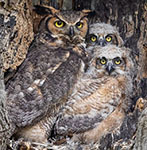 5/4 – Town of Poughkeepsie: As with bald eagle nests, locations of great horned owl nests, in this instance with owlets, must be left very vague. Baby owls can attract much inappropriate attention. This female great horned owl barely had room to squeeze into a photo, which we took from a non-threatening distance. (Photo of great horned owl courtesy of John Badura) 5/4 – Town of Poughkeepsie: As with bald eagle nests, locations of great horned owl nests, in this instance with owlets, must be left very vague. Baby owls can attract much inappropriate attention. This female great horned owl barely had room to squeeze into a photo, which we took from a non-threatening distance. (Photo of great horned owl courtesy of John Badura)
– John Badura
5/4 – Saratoga Springs, HRM 182: Spring bird migration is remarkable! I counted 43 bird species during this morning’s visit to Bog Meadow Brook Nature Trail and Meadowbrook Preserve. Among them were three Virginia rail, two of which were quite vocal and nine rusty blackbirds, possibly more. I could hear their melodious cacophony in the marshy forest past the boardwalk.
– Ron Harrower (Hudson-Mohawk Bird Club)
5/4 – Putnam County, HRM 52: Having committed my time to birdwatching while working from home in Mahopac, I moved our feeders to a more convenient viewing location and removed the screen from the window between us. It’s been great fun watching, photographing, and learning the names of the many species that regularly visit. In the last week of April, I was thrilled to see a new one for me, a male rose-breasted grosbeak. He returned to my feeders for several days but not since. I wonder if our home was just a stop-over for him on his way to breeding points north?
– Steve Rock
5/4 – Hook Mountain, HRM 31: We counted just six migrating raptors today at the Hook Mountain Hawkwatch, four of which were broad-winged hawks. The other two were sharp-shinned hawks.
– Ajit I. Antony, Liza Antony
5/5 – Town of Greenwich, HRM 190: The Carters Pond Wildlife Management Area seemed like a whole new world of birds today as I counted 41 species during my visit. The pond was very quiet, but the woods were alive with sound. New migrants included spotted sandpiper, great-crested flycatcher, Baltimore oriole, swamp sparrow, and yellow warbler—what a wonderful change of color! Other notables included American redstart, blue-gray gnatcatcher, least flycatcher, veery, and common raven.
– Scott Varney (Hudson-Mohawk Bird Club)
[Carters Pond is a NYSDEC regulated Wildlife Management Area that helps to provide a resting-staging area for waterfowl and other migratory species. The focal point of the area is Carters Pond, which has both open water and significant swamp and marshy areas. There is a one-mile loop trail along the southern end of the property—a great spot for migratory songbirds. One of my favorite sections is the wooded swamp area along Ferguson Road on the east side. Every year, Carters Pond hosts bald eagles, osprey, many wood warblers, vireos, tanagers, sparrows, rails, herons, grebe’s, and waterfowl. Scott Varney]
5/5 – Ulster County: I managed to get in position today to have a good view of bald eagle nest NY142. The smaller adult (male?) was proudly sitting by the nest. I waited an hour hoping that a fresh fish would be delivered, but no luck. One of the two nestlings moved around enough so that I caught some glimpses of its growing wingspan. They are rather gangly right now, but one day soon they will be magnificent. I saw just brief looks at the second nestling, and the two seem to be of different sizes. That is generally the result of a delayed hatch.
– Mario Meier
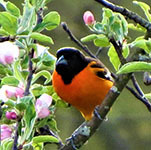 5/5 – Ulster County, HRM 87: I count myself among the fans of Baltimore orioles. They are an absolutely exotic bird, perhaps rivaled only by the male scarlet tanager. The orioles were in the apple trees, their flaming orange in stark contrast to their jet black and all accented by the May-time apple blossoms. (Photo of Baltimore oriole courtesy of Mario Meier) 5/5 – Ulster County, HRM 87: I count myself among the fans of Baltimore orioles. They are an absolutely exotic bird, perhaps rivaled only by the male scarlet tanager. The orioles were in the apple trees, their flaming orange in stark contrast to their jet black and all accented by the May-time apple blossoms. (Photo of Baltimore oriole courtesy of Mario Meier)
– Mario Meier
5/5 – Beacon, HRM 61: Beach seining in public had taken on a new character since the advent of the COVID-19 coronavirus. In pre-social-distancing times, beach-walkers, beachcombers, hikers, swimmers, or families simply enjoying the water, would amble over to see what we were up to. From their approach, fueled by curiosity, would come a series of questions: What are you doing? Is the water safe? What do you hope to catch? Is it legal?
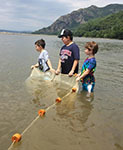 However, in the time of face masks and minimal six-foot distancing, today’s onlookers projected eerie, silent stares from no less than twenty feet away. The list of questions was undoubtedly on their minds, but they seemed reluctant to speak. Perhaps they wondered if communicating with us would somehow violate the principles of shelter-in-place. However, in the time of face masks and minimal six-foot distancing, today’s onlookers projected eerie, silent stares from no less than twenty feet away. The list of questions was undoubtedly on their minds, but they seemed reluctant to speak. Perhaps they wondered if communicating with us would somehow violate the principles of shelter-in-place.
Here are the answers to the questions never asked: We were beach-seining; the river was not un-safe other than it being 54 degrees Fahrenheit (F), and I was quite chilled in my shorts; we were looking to catch whatever was home in the river, purely out of curiosity and in the interest of science, we managed only a school of spottail shiners; and we were quite legal. (Photo of seining courtesy of Tom Lake)
– Tom Lake, Phyllis Lake
[Students frequently ask, “Why do we seine?” Seining is like a mystery. It is a doorway into a river that we cannot otherwise see or experience. We seine for understanding, for the magic of discovery. Seining offers us a personal relationship with the river; the anticipation renders seining almost like a romance. As the net comes in and the twine is unfurled, the experience can be akin to opening a present. Most of all, seining is like reading a book that is filled with knowledge.
The word seine is both a noun and a verb. As a noun, a seine is a net with a float-line on top, a lead-line on the bottom, and tight meshes in between. Seine is from the Latin sagëna, which means a fishing net designed to hang vertically in the water, the ends of which are drawn together to enclose fish. Those mentioned in the Almanac range in size from 15-to-200-feet-long, four-to-eight-feet in depth, with a float-line on top, a lead-line on the bottom, and tight meshes in-between.
As a verb, seining is an extraordinary tool used to sample an area and collect aquatic animals without undue injury to the catch. Unlike birds, butterflies, or wildflowers, all easily viewed, fish are a cryptically mysterious part of our community of life. Although they are an important measure of how well we are treating our waterways, they are largely hidden, unseen until we use our nets to bring them to hand. Tom Lake]
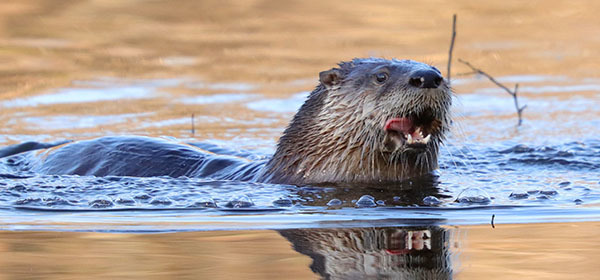
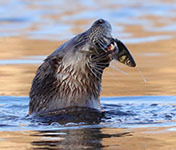 5/5 – Rockland County, HRM 42: I visited a lake in Harriman early this morning, and I noticed a bald eagle perched on top of a beaver lodge. There was also a river otter next to the lodge. The otter quickly slid into the water and the eagle flew into a nearby tree. I couldn’t believe they were fishing together! I guess the eagle was picking at the scraps that the otter left. I sat and watched the otter for a while as it shredded through four yellow perch, one after another. (Photo of river otter courtesy of Amy Comerford) 5/5 – Rockland County, HRM 42: I visited a lake in Harriman early this morning, and I noticed a bald eagle perched on top of a beaver lodge. There was also a river otter next to the lodge. The otter quickly slid into the water and the eagle flew into a nearby tree. I couldn’t believe they were fishing together! I guess the eagle was picking at the scraps that the otter left. I sat and watched the otter for a while as it shredded through four yellow perch, one after another. (Photo of river otter courtesy of Amy Comerford)
– Amy Comerford
[During a winter bald eagle-viewing program at Norrie Point several years ago, we witnessed a similar symbiotic relationship between an otter and an eagle. On that January day, the river was filled with seaward-drifting ice floes. An adult bald eagle was riding one of the floes dining on a big gizzard shad. Eagles often eat the good parts and then leave the remnants behind. Just seconds after the eagle took off to hunt some more, a river otter hauled out onto the floe and took possession of the rest of the fish. Tom Lake]
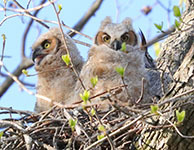 5/5 – Rockland County, HRM 32: I have been monitoring a great horned owl family in Congers for more than a month. The owlets are growing very fast and soon will be stepping out onto branches. I keep a far distance, hidden behind a tree, and use a zoom lens so as to not disturb them. While the adult female is usually in and around the nest, the dad always hangs around in a tree nearby. (Photo of great horned owl courtesy of Amy Comerford) 5/5 – Rockland County, HRM 32: I have been monitoring a great horned owl family in Congers for more than a month. The owlets are growing very fast and soon will be stepping out onto branches. I keep a far distance, hidden behind a tree, and use a zoom lens so as to not disturb them. While the adult female is usually in and around the nest, the dad always hangs around in a tree nearby. (Photo of great horned owl courtesy of Amy Comerford)
– Amy Comerford
5/6 – Fort Lee, New Jersey: I was in the Palisades Interstate Park’s Fort Lee Historic Site in late afternoon looking for birds. I came upon an immature red-tailed hawk (maintaining social distance) and a large, adult groundhog (Marmota monax). The hawk hopped up on a stump while the groundhog was near a hole at the base of a tree. They stared at each other for some time, the hawk turning its head in all directions to get a good look while the groundhog went in and out of the hole. This stalemate went on for a while until a couple of blue jays dive-bombed the hawk and the show was over.
– Chris Murphy
5/6 – Annandale-on-Hudson, HRM 98.5: My sojourn into the Saw Kill today had me fishing below the first waterfall to the head of tide. Smallmouth bass (Micropterus dolomieu) had moved into the tributary in preparation for spawning. I caught three, not a record in either numbers or size, but definitive evidence of the potamodromous migration.
Who says lightning never strikes twice in the same place? I caught a “tiger trout” today in exactly the same place in the Saw Kill as three years ago. [See the Almanac, April 23, for the tiger trout story.]
– Bob Schmidt
[There are basically three modes of migration for Hudson River watershed fishes:
– Potamodromy is migration within the freshwater reach of the watershed. Examples include smallmouth bass, yellow perch, white perch, and white suckers.
– Anadromy is migration of adult fish from the sea to freshwater to spawn. Examples include American shad, river herring, striped bass, and Atlantic sturgeon.
– Catadromy describes fish living in fresh water and going to the sea to spawn. The best example is the American eel. Tom Lake]
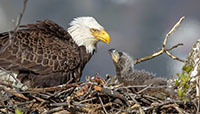 5/6 – Town of Poughkeepsie: The lone nestling in bald eagle nest NY62 was growing rapidly on a rich diet of river fish. A decade or more ago, this would have been the time when DEC’s Pete Nye would climb the nest tree to band the six-week-old nestling. The nestling would move across the nest to avoid Pete, requiring one of us to be stationed under the nest with a huge landing net just in case the nestling decided an early flight was its best option. That was a rare occurrence. (Photo of bald eagles courtesy of John Badura) 5/6 – Town of Poughkeepsie: The lone nestling in bald eagle nest NY62 was growing rapidly on a rich diet of river fish. A decade or more ago, this would have been the time when DEC’s Pete Nye would climb the nest tree to band the six-week-old nestling. The nestling would move across the nest to avoid Pete, requiring one of us to be stationed under the nest with a huge landing net just in case the nestling decided an early flight was its best option. That was a rare occurrence. (Photo of bald eagles courtesy of John Badura)
– Tom Lake
[When the bald eagle was removed from the Endangered Species List in 2007, banding was suspended. Tom Lake]
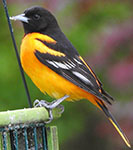 5/6 – Putnam County, HRM 52: It was cloudy today, so a bright flash of color outside my window was very noticeable. I’d been hoping for the return of a rose-breasted grosbeak, but instead it was my first Baltimore oriole. The vibrant oriole was keen on the suet that I hang between two feeders. It was such a welcome sight on such a gray day. (Photo of Baltimore oriole courtesy of Steve Rock) 5/6 – Putnam County, HRM 52: It was cloudy today, so a bright flash of color outside my window was very noticeable. I’d been hoping for the return of a rose-breasted grosbeak, but instead it was my first Baltimore oriole. The vibrant oriole was keen on the suet that I hang between two feeders. It was such a welcome sight on such a gray day. (Photo of Baltimore oriole courtesy of Steve Rock)
– Steve Rock
5/6 – Bedford, HRM 35: There were six heron guardians standing on their nests at the great blue heron rookery. One nest had a pair standing, but no nestlings were visible. A couple of nests still had herons settled down either incubating or keeping the nestlings warm—they will not be visible until they are larger. There was a single heron perched on a nearby tree. It was a bit darker in color which made me think that it was an immature, a yearling that left the nest last year. Great blue herons take two years to mature.
– Jim Steck
5/7 – Waterford, HRM 158: This was the third week for the eaglets in bald eagle nest NY485 at Peebles Island State Park. After all the excitement of incubation and hatching, there has been a slowdown in activity to just procuring fish from the Mohawk and Hudson rivers.
– Howard Stoner
[Peebles Island State Park is a 190-acre state park located at the confluence of the Mohawk and Hudson rivers. Most of the park is located in Saratoga County with a smaller portion in Albany County. For a map and list of hiking trails, visit https://www.parks.ny.gov/parks/attachments/PeeblesIslandTrailMap.pdf Tom Lake]
5/7 – Saugerties, HRM 102: I saw the harbor seal in late afternoon in Esopus Creek next to Tina Chorvas Waterfront Park off the sunken barge at Cantine Island. He was diving and splashing near three anchored fishing boats. This was Day 277 for the seal at Saugerties and, by all accounts, he appeared healthy.
– Patrick Wadden
 5/7 – Kowawese, HRM 59: We were on the beach just before first light. The world was in black-and-white. With no wind, the river was flat and still cold (51 degrees F). There was a very low tide on the full moon; last night’s extra high tide had run more than fifty feet up on the low-gradient beach. It left behind a tideline of branches, sticks, and other debris, with a broad, slick, sandy expanse in between. 5/7 – Kowawese, HRM 59: We were on the beach just before first light. The world was in black-and-white. With no wind, the river was flat and still cold (51 degrees F). There was a very low tide on the full moon; last night’s extra high tide had run more than fifty feet up on the low-gradient beach. It left behind a tideline of branches, sticks, and other debris, with a broad, slick, sandy expanse in between.
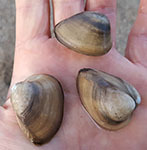
Given the early season, our seining catch was minimal. Local resident and native fishes included spottail shiners (47-52 mm) and tessellated darters, as well as one nonnative, a yearling channel catfish (class of 2019). As we walked off the beach, the sun peaked over Bald Mountain. In the forest, the orioles that arrived a few days ago to set the trees on fire, were joined today by waves of yellow warblers. (Photo of wedge rangia courtesy of Gareth Hougham)
– Tom Lake, A. Danforth
[As the tide dropped, we found wedge rangia (Rangia cuneata) clam shells (valves) on the beach (22-24 mm). The wedge rangia is a bivalve mollusk native to more southerly brackish coastal and inshore waters such as Delaware Bay and Chesapeake Bay. We initially found them on low tide beaches in Rockland and Westchester counties in the early 1990s. It is believed that they were inadvertently introduced to the lower estuary about thirty years ago. The clams were transmitted through fish boxes and crates filled with blue crabs headed up the coast from Chesapeake Bay to Fulton Market in Manhattan. From there, the empty boxes were then dispersed to commercial fishermen upriver to be rinsed and reused. They are now found as far upriver as Newburgh. Tom Lake]
5/7 – Hook Mountain, HRM 31: We counted just five migrating raptors today at the Hook Mountain Hawkwatch, three of which were osprey. The other two, one each, were broad-winged and sharp-shinned hawks. Non-migratory raptors included a distant adult bald eagle to the south-southeast carrying a three-foot-long American eel, as well as turkey and black vultures (5 each).
Three days ago, we had northwest winds with minimal migrants, as it was today. It seems that the spring migration at this site is largely over, so this will be our last day here. See you back in the fall.
– Ajit I. Antony, Liza Antony
*** Fish of the Week ***
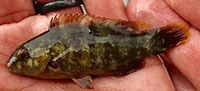
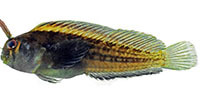 5/8 – Hudson River Watershed: Fish-of-the-Week for Week 69 is the freckled blenny (Hypsoblennius ionthas) number 204 (of 230) on our watershed list of fishes. If you would like a copy of our list, e-mail: trlake7. 5/8 – Hudson River Watershed: Fish-of-the-Week for Week 69 is the freckled blenny (Hypsoblennius ionthas) number 204 (of 230) on our watershed list of fishes. If you would like a copy of our list, e-mail: trlake7.
[The freckled blenny is a small, scaleless, yellowish green-to-brown fish with feather-like cirri above their eyes. They have blunt heads, large eyes, and a large continuous dorsal fin. Females have distinct “freckles” on their face. Their lower jaw has a row of small, close-set teeth like those of a comb, thus their family name, combtooth blennies (Blenniidae).
They are benthic (bottom) dwellers where they often burrow in the soft bottom and find refuge in old mollusk shells especially oysters, and can grow to 100 mm. Unlike the feather blenny (a temperate marine resident) the freckled blenny is a tropical marine stray.
The freckled blenny ranges from the Carolinas south into the Gulf of Mexico. It was added to our watershed fish list from a single fish (54 mm) caught at river mile 43 (Indian Point) by Normandeau Associates Inc., an ecological consultant, on November 22-23, 1985. The most northern record, other than ours, appears to be from the mouth of the Cape Fear River in North Carolina, suggesting that our freckled blenny may have been a ballast introduction. (Photo of freckled blenny courtesy of USGS)
– Tom Lake
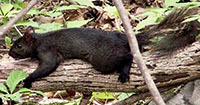 5/8 – Hudson River Watershed: A friend upstate told me that there are many “black” squirrels around Ogdensburg (Saint Lawrence County). Are they common in the Hudson River watershed? Are they just gray squirrels? (Photo of melanistic squirrel courtesy of Dan Marazita) 5/8 – Hudson River Watershed: A friend upstate told me that there are many “black” squirrels around Ogdensburg (Saint Lawrence County). Are they common in the Hudson River watershed? Are they just gray squirrels? (Photo of melanistic squirrel courtesy of Dan Marazita)
– Art Filler
[Black squirrels are a melanistic subgroup most common in our area with the eastern gray squirrel (Sciurus carolinensis). These squirrels have increased melanin resulting in black fur. They share this trait with chipmunks (Tamias striatus), also of the family Sciuridae. Biologists have suggested that black squirrels may have a selective advantage (natural selection–favored trait) over gray squirrels due to an increased cold tolerance resulting from black, heat-absorbing fur. It is also thought that black squirrels may have been predominant throughout North America prior to the arrival of Europeans in the 16th century, when America’s old growth forests were still abundant and thick. The black squirrels’ dark color helped with better concealment from its natural predators (owls and hawks) in these very dense and shaded old growth forests. While overall, they are not particularly rare in the Hudson Valley–they are common in parts of Canada–it is estimated that only about one in 10,000 gray squirrels is melanistic. Tom Lake]
5/8 – Wappinger Creek, HRM 67.5: This location has long been one of my favorite early-season spots to just cast a lure and see what happens. We were at the head-of-tide,1.6 miles upstream from the Hudson River, and any one of a half-dozen species of fish might strike at a lure. Here, the creek tumbles down a long series of rocky rapids from small pools fed by Wappinger Lake as it comes over a dam in the Village of Wappinger Falls, another half-mile upstream. There are well-aerated plunge pools that fill up on high tide, and today they were home to 6-9-inch smallmouth bass. These gamefish belie their small size with strong acrobatic jumps, swapping ends, and then smacking back into the water. All were safely returned to the creek, perhaps having gained a bit more caution of artificial foods passing by. The water was 55 degrees F.
– Tom Lake, A. Danforth
[The New York State DEC angling regulations for smallmouth and largemouth bass include an open season from the third Saturday in June (June 20) through November 30, five fish per-day creel limit, and a minimum size of 12-inches. For the rest of the year, regulations include catch-and-release and artificial lures only. Tom Lake]
5/8 – Orange County, HRM 67: Flowering dogwood (Cornus florida), a native species, was in full bloom acting as a brilliant and colorful segue to the last of the shadbush in the forest. A cursory check showed that the new oak leaves were now “the size of a squirrel’s ear.”
– Tom Lake
[In the time before the arrival of Europeans to the Hudson Valley, the cultivation of maize, or corn, was important for native Americans. In our area, these were Algonquian-speakers as well as the Haudenosaunee (Iroquois).
There is much ancient lore regarding the time to plant corn. Ethnographic (oral) traditions among many Northeast Indian tribes suggested planting corn when the new oak leaves were the size of a squirrel’s ear. But what is the size of a squirrel’s ear? One spring I decided to find out. I spent the month of April driving around the Hudson Valley measuring the ears of road-killed gray squirrels. Across that month, I received many odd stares from homeowners and motorists including a town police officer and a deputy sheriff both of whom wanted to know why I was “playing” with dead squirrels in the middle of the road.
Nevertheless, I measured 116 squirrels x 2 ears each. It turned out that the average “ear size” was 20.6 (mm), or 0.82 inches long. This might apply to different oaks in different areas, but for the Hudson Valley, it was probably the red oak (Quercus rubra). In most years the prime date arrives in early May and is probably related to soil temperature, rainfall, and perhaps some other factors. Tom Lake]
|

