Compiled by Tom Lake, Hudson River Estuary Program Consulting Naturalist
Overview
It has become almost an autumn ritual that western species of hummingbird show up in the Hudson Valley, as occurred this week. These are wandering migrants that are flushed south by lessening daylight, colder weather, and a reduced food supply. Raptors, vultures, and songbirds continued their southward flight, as winter ducks began to fill in the watershed’s coves and marshes.
Highlight of the Week
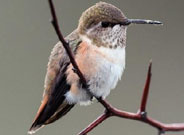 11/9 – Columbia County: An immature female rufous hummingbird, in a torpid state, was picked up today in Kinderhook and turned over to the care of a licensed rehabilitator. The bird was emaciated with zero fat reserves. The immature rufous was resuscitated and was now doing well and feeding actively. (Photo of rufuos hummingbird courtesy of Audubon) 11/9 – Columbia County: An immature female rufous hummingbird, in a torpid state, was picked up today in Kinderhook and turned over to the care of a licensed rehabilitator. The bird was emaciated with zero fat reserves. The immature rufous was resuscitated and was now doing well and feeding actively. (Photo of rufuos hummingbird courtesy of Audubon)
– Rich Guthrie
[While the native range of the rufous hummingbird (Selasphorus rufusis) is the far west U.S., they are known to wander widely with migrations up to 2,000 miles. They have been found, on occasion, in almost every part of North America. Tom Lake]
Natural History Entries
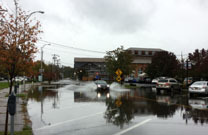 10/27 – Kingston HRM 92: After hearing of a National Weather Service flood warning for the Hudson River at Poughkeepsie for this afternoon [high tide 2:45 p.m.], I headed to the Kingston waterfront in late afternoon. While it was not the worst flooding I have seen, the Rondout Creek was challenging the height of the bulkhead, the low dock used for crew team rowing was buckled (usually this is an even-graded slope downward), the road near the Hudson River Maritime Museum was flooded, and the road out to Kingston Point Park was inundated. For the day, we measured more than an inch of rain. (Photo of Rondout strand flood courtesy of Nancy Beard) 10/27 – Kingston HRM 92: After hearing of a National Weather Service flood warning for the Hudson River at Poughkeepsie for this afternoon [high tide 2:45 p.m.], I headed to the Kingston waterfront in late afternoon. While it was not the worst flooding I have seen, the Rondout Creek was challenging the height of the bulkhead, the low dock used for crew team rowing was buckled (usually this is an even-graded slope downward), the road near the Hudson River Maritime Museum was flooded, and the road out to Kingston Point Park was inundated. For the day, we measured more than an inch of rain. (Photo of Rondout strand flood courtesy of Nancy Beard)
– Nancy Beard
10/27 – Little Stony Point, HRM 55: The river came up, and then the river came in. High tide [1:45 p.m.] easily overran the beach and continued inland. By the time the tide slackened, more than an hour later, the river had reached into areas of the flood plain – hundreds of feet inshore – that I had never seen under water. Thousands of water chestnut seeds and all manner of flotsam were deposited in places that will cause beach-goers to puzzle how they got there.
– Tom Lake.
10/31 – Manhattan, HRM 1: We checked our research sampling gear in Hudson River Park at The River Project’s sampling station on the lighthouse tender Lilac at Pier 25 and found five young-of-summer blue crabs ranging in size from 10-35 millimeters (mm). Sharing the killifish pot were two skilletfish (15, 60 mm) and a gorgeous immature black sea bass (70 mm).
– Siddhartha Hayes
[Note: one inch = 25.4 millimeters (mm)]
11/1 – Manhattan, HRM 1: When we returned to our research sampling gear in Hudson River Park at The River Project’s sampling station on the lighthouse tender Lilac at Pier 25, we found a pretty slim haul. The highlight was a young-of-year oyster toadfish (35 mm). Sharing the gear was a single, tiny blue crab (15 mm).
-Siddhartha Hayes
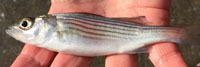 11/2 – Manhattan, HRM 1: With dropping water temperatures, our expectations were limited when we checked our research sampling gear in Hudson River Park at The River Project’s sampling station on the lighthouse tender Lilac at Pier 25. While we caught only a single fish, it was a good one, a young-of-year striped bass (75 mm). (Photo of striped bass courtesy of Tom Lake) 11/2 – Manhattan, HRM 1: With dropping water temperatures, our expectations were limited when we checked our research sampling gear in Hudson River Park at The River Project’s sampling station on the lighthouse tender Lilac at Pier 25. While we caught only a single fish, it was a good one, a young-of-year striped bass (75 mm). (Photo of striped bass courtesy of Tom Lake)
– Siddhartha Hayes
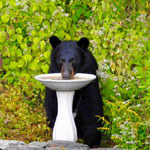 11/3 – Millbrook, HRM 82: I have a heated birdbath that attracts both birds and squirrels year around. Today, I had a different kind of visitor. We have had a female black bear and her cub around this summer, so I was not surprised when she showed up today, settled comfortably at the birdbath, and had a long drink. (Photo of black bear courtesy of Linda Vandel) 11/3 – Millbrook, HRM 82: I have a heated birdbath that attracts both birds and squirrels year around. Today, I had a different kind of visitor. We have had a female black bear and her cub around this summer, so I was not surprised when she showed up today, settled comfortably at the birdbath, and had a long drink. (Photo of black bear courtesy of Linda Vandel)
– Linda Vandel
[The DEC released a Guidance to Homeowners on how to avoid problems with black bears.
http://www.dec.ny.gov/press/113258.html]
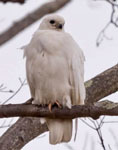 11/3 – Clinton Corners, HRM 82: The leucistic red-tailed hawk, known as “Lucy”, was in her usual area of Clinton Corners this morning. Deb Tracy-Kral has been photographing this Stanfordville-Clinton Corners red-tail for at least six years. (Photo of red-tailed hawk courtesy of Jody Preuss) 11/3 – Clinton Corners, HRM 82: The leucistic red-tailed hawk, known as “Lucy”, was in her usual area of Clinton Corners this morning. Deb Tracy-Kral has been photographing this Stanfordville-Clinton Corners red-tail for at least six years. (Photo of red-tailed hawk courtesy of Jody Preuss)
– Barbara Mansell (Ralph T. Waterman Bird Club)
[Leucism is an abnormal plumage condition caused by a genetic mutation that prevents pigment, particularly melanin, from being properly deposited on a bird’s feathers. As a result, the birds do not have the normal, classic plumage colors listed in field guides, and instead, the plumage have several color changes, including: white patches where the bird should not have any; paler overall plumage that looks faint, diluted or bleached; overall white plumage with little or no color discernable. Leucism affects only the bird’s feathers, and typically only those with melanin pigment – usually dark feathers. Birding.about.com]
11/3 –Town of Wappinger, HRM 67: Rather than a “flight day,” this was a flight afternoon. Following three inches or rain, a cold front swept through and brought strong northwest winds. All manner of bird was getting a tailwind. Across an hour, we counted three dozen turkey vultures streaming south (no need for kettles). We spotted two dozen raptors. However, except for a few lower-flying sharp-shinned hawks, a couple of red-tailed hawks, and at least one red-shouldered hawk, they were quite anonymous against the deep blue sky.
– Tom Lake, T.R. Jackson
11/3 – Rockland County, HRM 31: There was a strong northwest wind today, gusting to 38 mph and wind-chills in the low 30’s at the Hook Mountain Hawkwatch. Turkey vultures (55) and black vultures (12) seemed to benefit. Red-tailed hawks (11) were high count among raptors.
– Danielle Gustafson
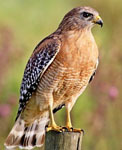 11/4– Bedford, HRM 35: Most of today’s flight at the Bedford Audubon Chestnut Ridge Hawkwatch occurred to the west at manageable heights. Turkey vultures (51) were high count among the migrants with red-tailed hawk (14) high among raptors. Red-shouldered hawk (7) made a good showing as well. Non-raptor observations included 383 American robins, 47 cedar waxwings, 80 American crows, 18 brant, and 107 common grackles. (Photo of red-shouldered hawk courtesy of Ira Runyan) 11/4– Bedford, HRM 35: Most of today’s flight at the Bedford Audubon Chestnut Ridge Hawkwatch occurred to the west at manageable heights. Turkey vultures (51) were high count among the migrants with red-tailed hawk (14) high among raptors. Red-shouldered hawk (7) made a good showing as well. Non-raptor observations included 383 American robins, 47 cedar waxwings, 80 American crows, 18 brant, and 107 common grackles. (Photo of red-shouldered hawk courtesy of Ira Runyan)
– Paul Tuck
11/4 – Rockland County, HRM 31: From the Hook Mountain Hawkwatch, we spotted a bird flying over Rockland Lake. We first thought it was a red-shouldered hawk, then a Cooper’s hawk. But, after looking closely at our photos, we decided it was a northern goshawk, our first of the season. Red-shouldered hawks (51) were high count among the 98 migrating raptors. Non-raptor observations included 50 double-crested cormorants and a common loon.
– Felicia Napier, Avril Armstrong, Kyle Bardwell, Steve Sachs, Tom Fiore
11/4 – Beacon, HRM 61: As the water temperature continued to drop, the fish seemed to be getting energized, perhaps as a prelude to winter. I landed just one carp today – a nice one (13 pounds, 9 ounces) – as well as six channel catfish. The largest of the catfish measured 22 inches and weighed about 5.0 pounds. This one was a male – large head and strong jaw structure – and it had a well-filled-in body. Sometimes male channel catfish have a very lean body. These all appeared healthy, and like the carp, were all returned to the river.
– Bill Greene
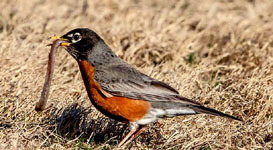 11/5 – Bedford, HRM 35: Most of today’s flight of red-tailed hawks at the Bedford Audubon Chestnut Ridge Hawkwatch was beyond the limits of binoculars. Our final tally was two red-tailed hawks and one Cooper’s hawk. Non-raptor observations included 199 American robins, 66 cedar waxwings, and 138 red-winged blackbirds.(Photo of American robin courtesy of Deb Quick) 11/5 – Bedford, HRM 35: Most of today’s flight of red-tailed hawks at the Bedford Audubon Chestnut Ridge Hawkwatch was beyond the limits of binoculars. Our final tally was two red-tailed hawks and one Cooper’s hawk. Non-raptor observations included 199 American robins, 66 cedar waxwings, and 138 red-winged blackbirds.(Photo of American robin courtesy of Deb Quick)
– Paul Tuck
11/5 – Yonkers, HRM 18: The Center for the Urban River at Beczak hosted the Biodiversity and Conservation Ecology class from the Sarah Lawrence College today for some sunset seining in the Beczak Marsh. In chilly and misty conditions, we were still fortunate to have a nice catch that included four shore shrimp, nine mummichogs, and a whopping 56 young-of-year striped bass!
– Eli Caref, Jay Muller
11/5 – Manhattan, HRM 1: We were very surprised when we checked our research sampling gear in Hudson River Park at The River Project’s sampling station on the lighthouse tender Lilac at Pier 25 and found a lone, young-of-year, seemingly out-of-season, butterfish (35 mm).
– Siddhartha Hayes
[Butterfish (Peprilus triacanthus) are a small (6-10 inches) rather rhombic-shaped fish lacking pelvic fins. It is found in the lower estuary when the river warms, and salinities rise. It is an important forage species for bluefish, striped bass, and summer flounder. Tom Lake]
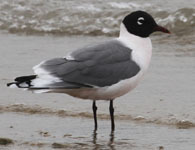 11/6 – Kingston, HRM 92: 6/5 – I spotted a Franklin’s gull this morning, an uncommon gull here, on the beach at Kingston Point. (Photo of Franklin’s gull courtesy of John Schwarz) 11/6 – Kingston, HRM 92: 6/5 – I spotted a Franklin’s gull this morning, an uncommon gull here, on the beach at Kingston Point. (Photo of Franklin’s gull courtesy of John Schwarz)
– Mark DeDea
[Franklin’s gull, a migratory bird, breeds in central Canada and northern United States and winters in South America. Tom Lake]
[In 25 years of the Hudson River Almanac, we have recorded 14 species of gulls in the watershed, along the tidewater Hudson, the Mohawk River, and adjacent uplands:
| – Black-headed gull |
– Herring gull |
– Little gull |
| – Bonaparte’s gull |
– Iceland gull |
– Mew gull (common gull) |
| – Franklin’s gull |
– Ivory gull |
– Ring-billed gull |
| – Glaucous gull |
– Laughing gull |
– Slaty-backed gull |
| – Greater black-backed gull |
– Lesser black-backed gull |
|
| Tom Lake] |
11/6 – Little Stony Pont, HR 55: A small stand of burning bush (Euonymus alatus) provided incredible color to an otherwise dull landscape today. While these are native to Asia, their presence in the forest seemed benign. Although their leaves were pink today, their common name comes from the bright red autumn leaves they would soon become.
– Tom Lake
11/7 – Bedford, HRM 35: Most of today’s flight at the Bedford Audubon Chestnut Ridge Hawkwatch was to the west-southwest at variable heights. Of the 106 migrants, 65 were either black vultures or turkey vultures. High count among raptors was red-tailed hawk (23). Non-raptor observations included 28 American robins and a monarch butterfly.
– Paul Tuck
11/7 – Rockland County, HRM 31: It was a lean 24 raptor-day today at the Hook Mountain Hawkwatch with sharp-shinned hawks (10) taking high count. Bald eagles (5) made a good showing as well.
– Steve Sachs
11/7 – Yonkers, HRM 18: We accompanied the interns from our Sarah Lawrence College Center for the Urban River at Beczak to the river today for seining. In six hauls, we captured Atlantic silverside, mummichogs, white perch, a gorgeous bluegill sunfish, and shore shrimp. However, our catch featured striped bass, as we caught 29 young-of-year (60-100 mm).
– Eli Caref, Jay Muller
11/7 – Manhattan, HRM1: We checked our research sampling gear in Hudson River Park at The River Project’s sampling station on the lighthouse tender Lilac at Pier 25 and found four young-of-summer blue crabs (10-25 mm), a handsome white perch (170 mm), and an amazing lined seahorse (60 mm).
– Siddhartha Hayes
11/8 – Saratoga County, HRM 182: During a mid-morning survey of Saratoga Lake with the Thursday Birding Group, we counted 34 bird species. Among them were Canada geese (1,200), bufflehead (53), American coot (4), two common loons, and a single osprey circling and diving. We also spotted a peregrine falcon crossing the lake and watched as it took a quick swipe at a passing ring-billed gull before continuing on its way.
– Ron Harrower (Hudson-Mohawk Bird Club)
11/8 – Little Stony Point, HRM 55: As we walked onto the beach, a common loon bobbed in the chop not far offshore. As the last glimmer of light faded behind Crow’s Nest, the cold came in, then the dark. The westerly breeze grew a bite. Under the new moon sky, we seined by starlight. Each haul in the dropping tide came in empty, but we were comforted by science’s axiom “no data is still data.” On our last haul, the collected leaves in the bag of the net rustled – we had fish. We could have done a survey on the hardwoods in the forest just by cataloging the leaves we caught. When the pickings get slim, the ordinary become special: The half-dozen bluegill sunfish (35-85 mm) and one gorgeous golden shiner (80 mm) made it all worthwhile. The river was 51 degrees Fahrenheit (F).
– Tom Lake, A. Danforth
11/8 – Bedford, HRM 35: Most of today’s flight of migrants at the Bedford Audubon Chestnut Ridge Hawkwatch was to the west-southwest at variable heights. We counted 93 of six species with turkey vulture (68) the high count. Red-tailed hawk (14) led the raptors; red-shouldered hawks (6) made a good showing. Non-raptor observations included 97 American robins, 488 red-winged blackbirds, 40 common grackles, and 35 cedar waxwings.
– Paul Tuck, Pedro Troche
11/8 – Rockland County, HRM 31: We tallied 77 raptors of seven species today at the Hook Mountain Hawkwatch. It was a big day for red-shouldered hawks (43).
– Vince Plogar, Frank Bonano
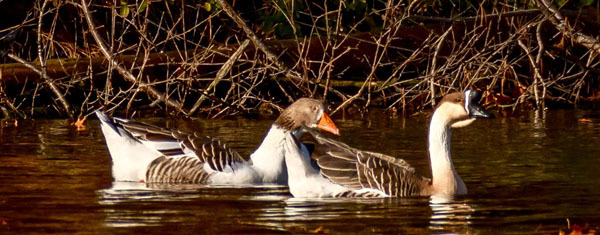
11/9 – Ulster County, HRM 85: I spotted a pair of geese at Sturgeon Pool today on the Wallkill River. From my photo, Steve Chorvas identified them as a gray lag goose (Anser anser), native to Europe and Eurasia, and a swan goose (Anser cygnoides), native to Asia. They were both likely escapees from captivity.
– Jim Yates
11/9 – Bedford, HRM 35: The Bedford Audubon Chestnut Ridge Hawkwatch saw 42 turkey vultures and 31 raptors pass by to the west-southwest today in migration. Red-shouldered hawks (11) were high count among raptor; red-tailed hawks (10) made a good showing. An immature bald eagle wondered in front of the count site. Non-raptor observations included 263 American robins, 488 red-winged blackbirds, 60 common grackles, and 45 Canada geese.
– Paul Tuck
11/9 – Rockland County, HRM 31: We had a great showing today of red-shouldered hawks (20) at the Hook Mountain Hawkwatch. Next high count among the 31 raptors was sharp-shinned hawk (5). Non-raptor observations included a flock of ten common ravens.
– Vince Plogar, Frank Bonano
[Because of the Thanksgiving Holiday, the Hudson River Almanac will resume on November 30.]
Autumn 2018 Natural History Programs
Monday, December 3 8:45 AM to 4:00 PM.
From the River to the Sea: Estuary-to-Ocean Teacher Conference
Henry A. Wallace Visitor and Education Center, FDR Presidential Library and Museum in Hyde Park Free; advance registration is required; sign up at https://tinyurl.com/HREPconference by November 28. Sponsored by the New York State DEC Hudson River Estuary Program and Teaching the Hudson River Valley.
Free Trees for Streamside Planting
The Hudson River Estuary Program’s Trees for Tribs program offers free native trees and shrubs for planting along the tributary streams in the Hudson River Estuary watershed. Our staff can help you with a planting plan and work with your volunteers. Since 2007, Trees for Tribs has provided more than 40,000 native trees and shrubs for planting along 20 miles of stream with the help of more than 9,000 local volunteers. We are now accepting applications for planting projects.
For more information about the program or to download an application, please visit the DEC website at: HudsonEstuaryTFT.
Hudson River Miles
The Hudson is measured north from Hudson River Mile 0 at the Battery at the southern tip of Manhattan. The George Washington Bridge is at HRM 12, the Tappan Zee 28, Bear Mountain 47, Beacon-Newburgh 62, Mid-Hudson 75, Kingston-Rhinecliff 95, Rip Van Winkle 114, and the Federal Dam at Troy, the head of tidewater, at 153. The tidal section of the Hudson constitutes a bit less than half the total distance – 315 miles – from Lake Tear of the Clouds to the Battery. Entries from points east and west in the watershed reference the corresponding river mile on the mainstem.
To Contribute Your Observations or to Subscribe
The Hudson River Almanac is compiled and edited by Tom Lake and emailed weekly by DEC’s Hudson River Estuary Program. Share your observations by e-mailing them to trlake7.
To subscribe to the Almanac (or to unsubscribe), use the links on DEC’s Hudson River Almanac or DEC Delivers web pages.
Discover New York State Conservationist – the award-winning, advertisement-free magazine focusing on New York State’s great outdoors and natural resources. Conservationist features stunning photography, informative articles and around-the-state coverage. Visit the Conservationist webpage for more information.
Useful Links
National Oceanic and Atmospheric Administration online tide and tidal current predictions are invaluable when planning Hudson River field trips.
For real-time information on Hudson River tides, weather and water conditions from sixteen monitoring stations, visit the Hudson River Environmental Conditions Observing System website.
DEC’s Smartphone app for iPhone and Android is now available at: New York Fishing, Hunting & Wildlife App. |


 Hudson River Almanac